European leaders taking cues from Australia on asylum seeker policies

Across Europe anti immigration political leaders are turning to Australia for inspiration on how to reduce the number of people seeking asylum in their countries.

Australia’s asylum seeker policies have attracted condemnation from human rights organisations and many countries around the world. But in speeches given at US President Barack Obama’s Leaders’ Summit on Refugees and the United Nations (UN) General Assembly in September, Prime Minister Malcolm Turnbull urged his fellow leaders to adopt Australia’s strict border protection policies.

In some quarters, the Australian perspective is taking hold.

In September, British Foreign Secretary Boris Johnson echoed the “stop the boats” mantra adopted over the years by Australian Prime Ministers John Howard, Kevin Rudd, Julia Gillard, Tony Abbott, and now Turnbull. Days later, in her speech to the UN General Assembly, British Prime Minister Theresa May spoke of the need for countries to exercise control over their borders.

The European Union’s (EU) deal with Turkey to send asylum seekers back in exchange for aid parallels Australia’s “Pacific Solution”, in which Australian governments outsource their processing of asylum seekers to third party countries.

Spain has developed a system of “border externalisation” similar to the Pacific Solution. Under the Spanish plan, Moroccan authorities in particular intervene to stop asylum seekers from setting sail, or from climbing the wall into the Spanish enclaves of Melilla and Ceuta. Sometimes they use violent force to achieve this.

Seville-based analyst Rafael Rodriguez Prieto has described this as the “Cerberus response”. This is a reference to the mythical three-headed dogs of Hades guarding the gateways to Hell, or in this case blocking the pathways at either end of Europe.

In the face of international condemnation, how does a country justify a hard-line stance on accepting asylum seekers?

The moral architecture behind Australia’s position is based on a number of ideas, from theories about human motivation drawn from behavioural economics to the concept of national self determination.

The right to sovereignty

Australia is a nation state emerging from the resolution of European wars in the 17th century under the Westphalia Treaty. Its legitimacy is based on claims that date back to the invasion of Aboriginal country by the British Crown in the 18th century, legislation enacted by the British parliament in the 19th century and the inheritance of that power by the Commonwealth in the 20th century.

Nation states are designed to define and protect particular ethno-religious polities against challenges brought by competing groups. Therefore, people entering the country who have not been sanctified by the state – “unauthorised arrivals” – can be resisted using force majeure.

In order to defend the legitimacy of the state, it is imagined permissible or even necessary to prevent the unauthorised arrival of those who might seek to claim refuge. In Australia’s moral architecture, this trumps any moral claims made by asylum seekers.

The greater good

In order to justify this action, it is necessary to claim that not only is there the national imperative, but an even greater moral good.

The first argument is the prevention of further deaths at sea as asylum seekers take to boats in an attempt to reach safer shores. The second is the refugee “pay-off”: that authorised refugees (preferably not Sunni Muslims) can be taken in increasing numbers.

Without “unauthorised” asylum seekers “jumping” the (non-existent) queue, there will be wider public support for authorised refugees. The Australian population will feel better about itself, and its reputation as having “one of the most successfulmulticultural societies in the world will be enhanced.

These arguments justify paying people smugglers significant sums to turn their boats around. They permit the paying of significant sums to adjacent states to hold the “illegals”, process their applications and “settle” them.

And they make it possible to ensure and accept that the conditions under which the asylum seekers are “protected” are sufficiently onerous, and the likelihood of salvation so distant, that asylum seekers will choose to return “home”.

Putting an end to people smuggling

The crucial element is the capacity to prevent a person seeking refuge from physically setting foot in the country.

Entering a country unauthorised is not in itself illegal – seeking refuge is an authorised action under international agreements. But nation states can trump international agreements by declaring the “attempt to arrive” as illegal, or deciding that the asylum seeker has no legitimate case for protection.

In Australia, the label of illegality does not result in criminal charges against the refugees, but against the boat crews who bring them. Together these elements are justified on the crude behavioural economics basis of removing the financial incentive for people smugglers.

Will Australia’s framework prevail?

The refugee crisis, generated in part by failed or failing states and likely to be exacerbated by climate change, positions contemporary ideologies of transnational collaboration against the realities of ethnic and nationalist solidarity and self-interest.

It is the beneficiaries of the Westphalia agreement (the advanced nation states of Europe and their clones, such as Australia) who have been most challenged by the emergence of transnational structures of governance such as the UN and the EU, despite their formulation of and participation in them.

What next?

Australia’s contribution to the response of the Global North to the crises of the Global South has already been quite powerful.

Following the Brexit decision in the UK, rafts of public servants in agencies such as the Home Office and the Equal Opportunities Commission have been charged with extracting the country from its European human rights obligations.

The “Australian solution” has already found influence, not only in the rhetoric of politicians such as the UK Independent Party’s Nigel Farage, but in the portfolio of responses being explored in the corridors of Whitehall.

Johnson’s call for an EU naval force deployed in the Mediterranean to turn back migrant boats after they leave Libya to stem the vast numbers of asylum seekers trying to get to Italy is one insight.

For as long as the Libyan state remains in crisis and unable to assert its sovereignty over its own waters, the British navy could take it upon itself to “stop the boats”. Or it could try to force its European counterparts to toughen up their border protection policies.

Either way, it sounds very Australian.

The Conversation

Andrew Jakubowicz, Professor of Sociology, University of Technology Sydney

This article was originally published on The Conversation. Read the original article.

Whosever one nation it is: explaining, please, what multicultural politics is about to become….

Why multicultural policy looms as a Senate bargaining chip

Andrew Jakubowicz, University of Technology Sydney

Prime Minister Malcolm Turnbull’s allocation of the multiculturalism portfolio to conservative ACT Liberal senator Zed Seselja could reflect a number of motivations, both rational and perverse.

Multiculturalism is once more in the crosshairs of its opponents. With senator-elect Pauline Hanson and News Corp commentator Andrew Bolt drawing on apprehensions about Muslims to drive their contributions to the heightening of social anxiety, how will Turnbull’s oft-proclaimed “most successful multicultural nation in the world” handle the rumbling?

Multiculturalism may well be supported by 80% of Australians, but this level drops when anxiety about border security rises. So, multiculturalism’s opponents have much to gain from heightened public concern about “Muslim immigration”.

Hanson’s election has helped clarify the sides of the debate around how Australians have “imagined community” for more than 30 years, since Geoffrey Blainey first shaped the opposition arguments. There is one nation with many cultures, which was Bob Hawke’s 1989 definition of multiculturalism. And then there should be only one culture albeit followed by many races, which is Hanson’s conceptualisation – though wrongly labelled as “One Nation”.

The first sees Australia as a civic nation in which reciprocity and difference, supported by core commitments to democracy and equality, provide the architecture for creativity and cohesion.

The second sees Australia as an (Anglo-Christian) ethnic (multicoloured) monocultural nation in which assimilation into an imagined singular worldview drives calls for cohesion and claims of social strength.

So what does the immediate and long-term future hold for Australian multiculturalism?

Hanson’s return

Hanson’s election to the Senate points to the transformative politics that have been re-ushered into federal political life, and into the wider debates around the nature of Australian race and cultural relations.

Her re-declaration of war on multiculturalism – she played a significant role last time around in John Howard’s reluctance to utter the “M” word – has provided a catalyst for what will be an intense debate over coming months and years.

This debate will not so much involve Hanson herself, but rather be conducted between the various multiple perspectives on cultural diversity, and to what extent and in what forms it should be institutionalised in Australia.

Yes, minister

Seselja celebrates a conservative multiculturalism. He says he supports the government’s position on leaving Section 18C of the Racial Discrimination Act unchanged, but he previously backed the conservative fallback position of removing the two more contested provisions about insult and offend.

When she was minister, Concetta Fierravanti-Wells made much of the multicultural communities’ supposed opposition to same-sex marriage; both she and Seselja share this opposition. This perspective could well have saved three or four Liberal seats on Chinese and Korean Christian Democrat preferences – including that of her successor, Craig Laundy.

Tony Abbott appointed Fierravanti-Wells to the portfolio. Turnbull replaced her with Laundy from the moderates, but now he has appointed someone from the right once more. Seselja will be firmly in Hanson’s sights in her push to have multiculturalism and all its works (like SBS) axed.

Perhaps Turnbull decided that either Seselja will be truly tested in this battle and apply his undoubted toughness, or that he and Hanson are so close together on so many other issues that they’ll cobble up a deal before the multicultural lobby groups wake up.

What to expect

Seselja, in interviews with ABC Radio National and SBS, has revealed he supports multiculturalism – by which he means honouring ethnic community tradition while joining the Australian mainstream.

As he is a member of the government, and for as long as the government position is to leave Section 18C alone, he will stand by that position – though he may still push internally to change it.

Seselja said “it’s reasonable that people feel unease” about Islamic terrorism in response to TV personality Sonia Kruger calling for an end to Muslim migration. However, he did reiterate the government’s position that the immigration program does not discriminate on religious grounds.

But Seselja did not publicly voice his support for members of the Muslim community who may feel intimidated or victimised by calls for Muslim immigration to be banned – a call now echoed by right-wing Tasmanian senator Eric Abetz. Nor did he distance himself from Kruger’s endorsement of Bolt’s “understanding” of the drivers for potential vigilante attacks on the Muslim community and its institutions.

Seselja indicated that reworking “Labor’s multiculturalism policy” was on his to-do list. This is bizarre, as the current policy was taken almost unchanged by Labor from the considered policy of containment and minimisation developed during the Howard era.

Multiculturalism will clearly be one of the trading goods carried in the saddlebags of the government’s peacemakers in the Senate. How it will be shed, and for what deals, remains to be seen. That its components will be among the first sacrifices offered seems most likely, but the multicultural communities that defended Section 18C are alert to the dangers.

The Conversation

Andrew Jakubowicz, Professor of Sociology, University of Technology Sydney

This article was originally published on The Conversation. Read the original article.
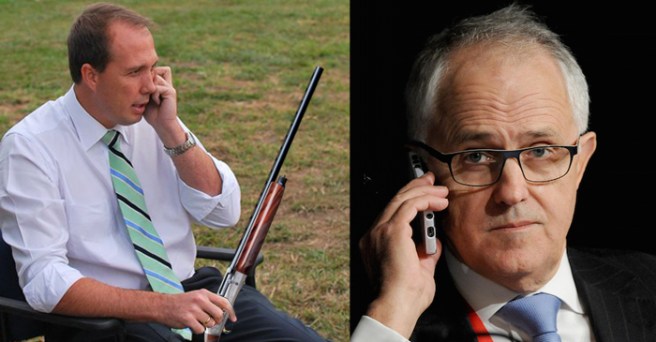
Politicians trashing immigrants and refugees are the real danger to social cohesion

Dutton-Shoot-themThe ConversationFrom the Betoota Advocate with thanks

Andrew Jakubowicz, University of Technology Sydney

In a bid to defend Immigration Minister Peter Dutton following his controversial comments on refugees, Prime Minister Malcolm Turnbull in a Fairfax op-ed made unjustifiable claims about the relationship between his government’s multicultural policy, Australia being a multicultural society, and stopping the boats.

Turnbull’s op-ed contained four serious implications:

  • that public support for multiculturalism as a policy for settlement and social cohesion solely depends on governments demonstrating control of borders;
  • that there are only costs associated with refugees (which “we do not begrudge”);
  • that the threat to multiculturalism comes only from unauthorised asylum seeker arrivals and any increase in authorised numbers that would overwhelm settlement services; and
  • that Australia is “the most successful and harmonious multicultural nation in the world”.

Each of these propositions is disingenuous and misleading.

Does multiculturalism depend on ‘strong borders’?

The issues of multiculturalism and immigration need to be separated. There is evidence uncontrolled borders erode community support for large immigration numbers. However, there is little evidence that support for multiculturalism is directly tied to support for particular levels of immigration.

Multiculturalism is a process of settlement and the building of mutual respect, not a basis for admission into the country. Support for multiculturalism in Australia hovers at about 80%, even while support for immigration levels rises or falls in relation to the perceived control governments have over national borders.

Research dating back to 1998 demonstrates that Australian support for high immigration levels remains well above 50% – unless people become anxious that multiculturalism will cause them specific harm.

Costs

The costs associated with the settlement of refugees are significant.

However, the additional costs the government claims an increased refugee intake would generate are tiny. Labor, which is promising to lift the intake from 13,750 to 27,000 by 2025, points out there would be no change in numbers until the fourth year of the forward estimates, and then only small numbers. At a A$17 million difference, it would hardly destroy the budget.

Even then, this addition at the margins would be well offset by the impact of refugees’ high propensity to consume, with its multiplier effects through the economy. They tend to spend nearly everything they get in their first few years in Australia. Begrudging the investment would be foolhardy given the benefits it generates.

Settlement services throughout Australia have been developing new strategies to engage with the one-off intake of 12,000 refugees fleeing the conflict in the Middle East.

NSW Premier Mike Baird has appointed a co-ordinator-general for refugee resettlement, Peter Shergold. Early reports suggest a greater level of integrated service planning and delivery than has ever happened before. This is generating higher efficiencies, greater community, institutional and business buy-in, and a more productive system unlikely to be overwhelmed by the intake Labor proposes.

Threats

While support for high levels of immigration has been more varied, the real killer for multiculturalism is the anxiety factor about the perceived threat of cultural diversity versus the perceived benefits.

The last time this was seriously tested was in 2007. Then-immigration minister Kevin Andrews announced, just before the election, the slashing of the African refugee intake. In another exacerbation of community anxiety, he claimed Africans apparently integrated poorly into Australia.

This was not only wrong – African young men were the target of racist violence, not the perpetrators – and insulting, but it shifted public opinion away from support for immigration and multiculturalism.

Tony Abbott repeated this in relation to Muslims. Senior politicians traducing the reputation of immigrants does more to erode support for multiculturalism than do uncontrolled borders.

Is Australian multiculturalism the world’s best?

There are two major indices that test this proposition. The Migrant Integration Policy Index (MIPEX) covers 28 countries. The Multiculturalism Policy Index (MCP) covers 21 countries. It contains three elements – immigrants, indigenous minorities and national minorities.

The 2014 MIPEX places Australia eighth out of 28 countries, marking it down on family reunion and other human rights issues. This is a more rigorous and extensive index. Its results do not support Turnbull’s claims.

The 2010 MCP immigrants list, which was undertaken during the Labor government and therefore not adjusted for changes under the Coalition, placed Australia at the top of the list with a “perfect” score. However, its indigenous minorities list of nine countries placed Australia fifth.

The Coalition specifically opposes key multicultural policy initiatives. It abolished (under John Howard) and now opposes an Office for Multicultural Affairs. It opposes and refuses even to discuss a Multiculturalism Act. But its multiculturalism minister, Craig Laundy, has identified the main advisory body, the Australian Multicultural Council, as unrepresentative and requiring change.

Finally, the Coalition has no plans to re-establish a policy–linked research capacity outside the limited program inside the Department of Social Services. This is despite its members supporting this move in opposition.

Turnbull was more correct to say governments that lose “control” of their borders see a decline in support for higher immigration levels. But to lose support for multiculturalism, governments have to trash the reputation of refugees, raise community anxiety and watch while they trigger the added complication of fragmentation in community cohesion.

This article was originally published on The Conversation. Read the original article.

Launch The Boy on the Tricycle by Marcel Weyland

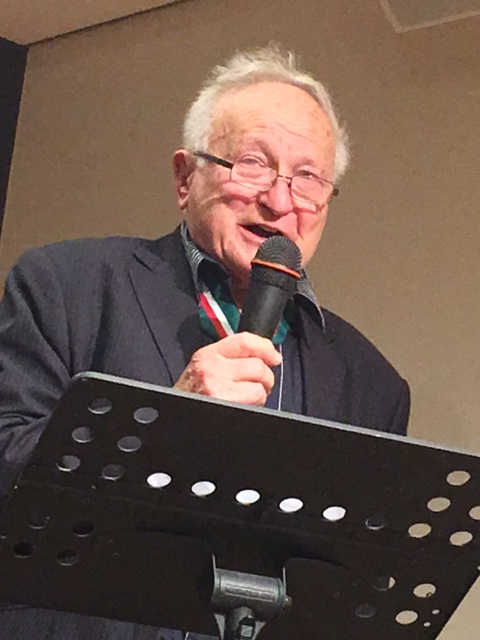
Andrew Jakubowicz  Launch 12 May 2016 at the Polish Consulate Woollahra Sydney.


IMG_1528.JPG
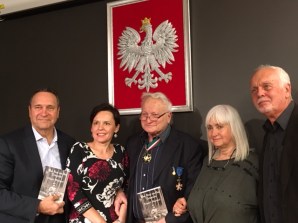
Andrew, Regina, Marcel, Veronica Sumegi (publisher), Phillip


While I have been in Marcel’s consciousness some few years more than he has been in mine, I am honoured that he has asked me, the nephew, to help launch this memory of a life well lived.

IMG_1535.JPG
Consul Regina Jurkowska, Marcel Weyland, Phillip Hinton


From my earliest memories he was part of my family world, with the trips from Bondi to the rambling mansion at Mosman, and my getting to know the line of cousins and that mysterious string of Irish relatives brought into our family through his marriage with Philippa.

PAulJuliaLaunch2016
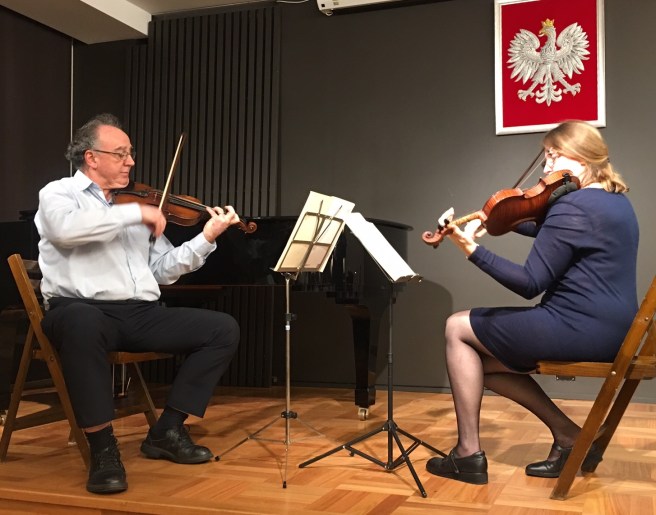
Paul and Julia Pokorny (daughter Marcel) play at beginning of evening

His life has trailed the history of the modern world, starting from the calm comfort of a bourgeois home in Lodz, Poland, and being completed but by no means finished now in the other bookend in Sydney, Australia, his ever spreading offsprings’ offspring melding with the children of other immigrants from all over the world.

IMG_1556.JPG
En famille…

I have seen his memoir emerge at a steady pace, and watched how memory and contemporary prospect intertwine and feed on each other. In June last year some of his memoir was shared via video in progress with family, friends and interested observers at a ceremony I attended in the Synagogue in Warsaw. Then three months later, the invitation to him I had been handed there and trusted to deliver by Japanese officials, was realised as he was guest of honour at a ceremony in Kaunas Lithuania to celebrate the 75th anniversary of the role that Chiune Sugihara had played in the survival of our family. While Marcel was in Kaunas, Mara and I were in Shanghai watching a musical “The Jews of Shanghai” performed to celebrate the end of the war against Japan, which permitted him to take the final voyage to freedom in Australia.

AndrewMarcelEaglelaunch120516
The Eagle, Andrew, Marcel

This is very much Marcel’s night, and it represents another milestone in an extraordinary career that he has developed as a bridge between the many societies where his life paused in its trajectory. Born in Poland, saved firstly from the Holocaust in Lithuania by British officials representing Poland, and by a Dutch and Japanese official who was running Polish secret agents, and then a Soviet officer, then permitted to escape across the USSR, settled for a time in Kobe, Japan, then shifted unceremoniously to Shanghai, where suddenly all forward movement halted, Marcel arrived with my parents and his mother in Sydney in September 1946 where his sister Maria, greeted him. This sputtering but magical journey is only one part of a tremendous life, part luck, part courage, part adventurous imagination.


There were many moments of extraordinary luck and serendipity, which he records with a wonderfully wry style in this book.   We were discussing one of those – why and how did he get to Shanghai, last year. I wanted to know more and after the trip to Shanghai and a turn in the archives there I had even more questions. There are at least three heroes in Marcel’s story – Chiune Sugihara, the Japanese consul in Kaunas; Jan Zwartendijk, the inventive Dutch honorary consul in the same city; and the Polish Ambassador to Japan Tadeusz Romer, who was moved from Tokyo to Shanghai about the same time Marcel was shipped from Kobe to that same city.

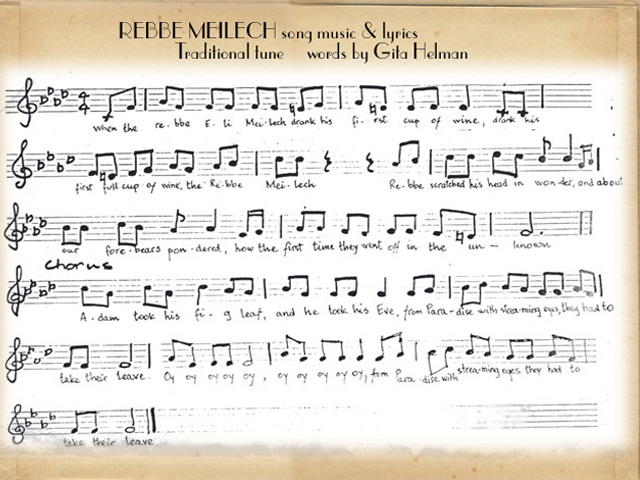
VilnaRebbeMeilichSongMusic copy
Marcel sang this song, in English (his translation), all verses at the launch: originally performed in Vilna in Polish, during winter 1940/41, in a refugee cabaret: Gila Helman perished there under the Nazis

Marcel and the family were on the last boat to Shanghai. Up until July 1941 the expectation of most of the 2000 Polish Jews who had used Sugihara and Zwartendijk papers to get to Japan, was that they would get out to North America, South America, Australia or Palestine. Maria had already secured a link to a refugee accepted by Canada, later known as Stefan Golston, serendipitously as we now know also a translator of Polish poetry. However at the end of July all shipping out of Japan to the west was halted, as was the flow of money to support the refugees from the USA. The civil authorities in Kobe decided that the final 1000 Poles had to leave, and they sent three ships to Shanghai. Our family remained in Kobe, maybe because they still hoped to get to Canada, maybe because unlike many others they were not destitute as my father worked for the local JewCom.

In Shanghai the Japanese military authorities were very unwelcoming; in their view the Polish Jews were undesirable and would not be allowed to land in Hongkew where the Jewish community had housing. The Vichy French banned entry to the French Concession. The Jewish community confronted the Shanghai Municipal Council, an international body run by British officials, and demanded they help, or they would cable Kobe and tell the refugees not to leave.

The confrontation continued – the community had housing where there was no entry allowed, and where entry was allowed they had no housing. When the third boat arrived at the end of August the passengers disembarked on the Bund and were first housed in the Museum Road synagogue.

PolandcafeRussianIMG_3310

The following day the community reported the synagogue as over crowded to the Council, demanding it find alternative accommodation. This ruse did not work but soon after the arrivals were allowed into some of the housing in Hongkew; the rabbinical students (about 300) stayed in the synagogue, and the others moved to the Jewish club in the French Concession. Marcel and our family arrived on a fourth ship that left Kobe on September 15. They were then moved to a house belonging to the Catholic church in the French Concession – we visited it again last year, preserved by the Shanghai city across the road from the Shanghai Hilton.

As the memoir notes, Marcel then tracked off to find a school, repeating an adventure from Kobe, and by October he was at the Shanghai Jewish School. Michal their father urged Maria, who had the Canadian visa, to take the last berth on a Dutch boat heading for Australia, entry arranged through Romer’s good offices. It would turn out to be the last ship out, and their expectation that Maria would do the necessary to help them also leave did not occur until June 1946.

IMG_1507.JPG
The singer sings his song

In 1943 the remaining family members were ordered to move into Hongkew (The Designated Area), where they lived in a house in Dalny Road. Mara and I saw it being demolished in 2000 for the new metro station near the Jewish Refugee Museum.

I want to make short mention here of five of the Polish Jews whose lives ended in Japanese custody, when they protested the move to the Ghetto. They tried to assert that they were Polish citizens not stateless refugees: to no avail. The five had all received Sugihara visas in Lithuania in 1940; they had travelled across the USSR and found refuge in Kobe in 1941; they had been shipped to Shanghai in late 1941, two on the last ship in September. In a very real sense they were the Jews who martyred themselves for the Polish cause; their names were Josef Altminc (from Warsaw, 45 yo, JDC Vilna list 64, Sugihara list 157, Polish consulate list 1340); Berysz Abramowicz (Sugihara list 1376, Polish consulate list 1054); Aleksander Halperson (Sugihara list 370, Polish consulate list 1200); Gersz Praskier (Sugihara list 1048, Polish consulate list 1131); and Teodor Finkelstein (Sugihara 1680).

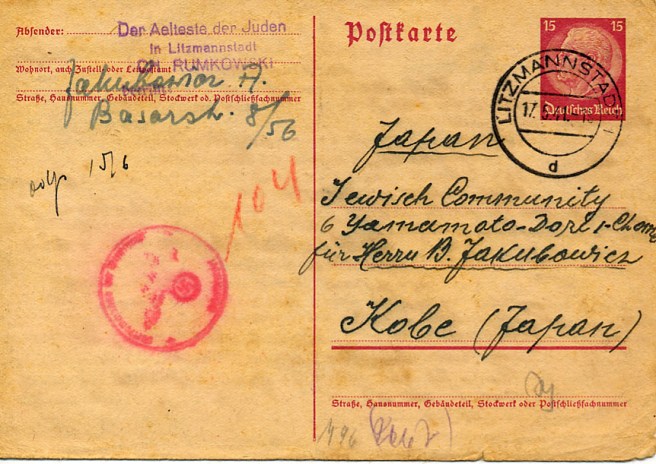
In September 1946 Marcel and his mother, with my parents, arrived by ship from Hong Kong on the SS Yochow, at Woolloomooloo. Michal had died of cancer in Shanghai in 1942. My father’s parents had perished in 1942 in the Litzmannstadt ghetto (Lodz) and at Kulmhof death camp (Chelmno) in Poland.

AJcardBJKobe5_41
Last contact: his father to my father, May 1941.

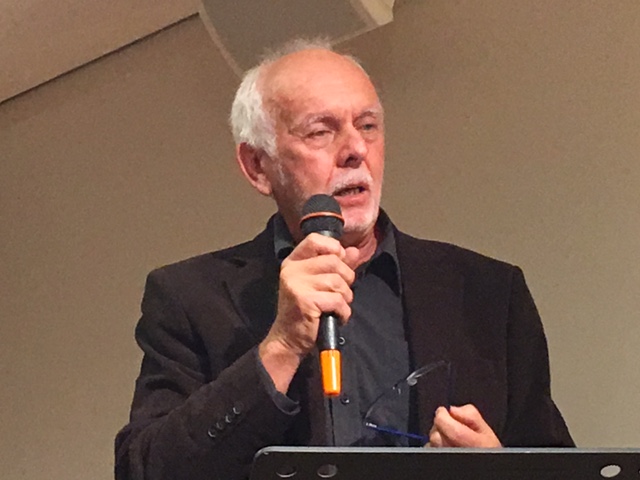
With great emotion and heartfelt thanks for his life and the magic that allowed him to live it, I declare the memoir of the boy on the tricycle launched, and ask Phillip Hinton to read to us from its wonderful text.


IMG_1501.JPG
Phillip Hinton in full flight
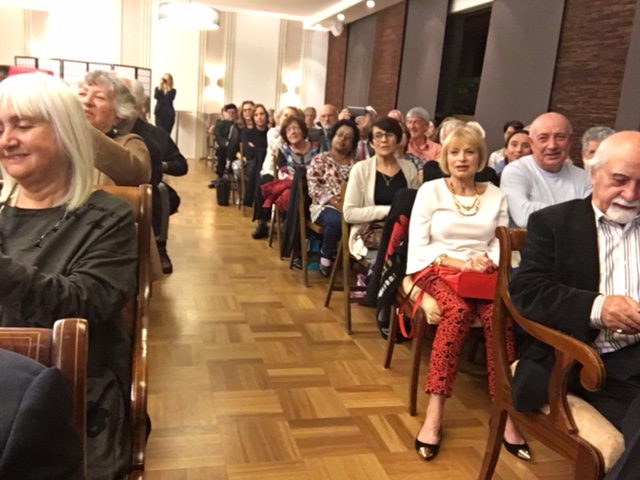
IMG_1511.JPG
The Crowd