| Contribution to ASSA Committee on Antisemitism and Social Cohesion Submission: April 2026
1. Introduction: The Stakes of Social Cohesion
For societies confronting their own internal violence, social unrest and conflict, Australia presents a distinctive and instructive case for the study of social cohesion. As first a collection of colonies, and then an immigration nation ten generations old, constructed upon the foundations of the oldest continuous cultures in the world, Australia has long navigated the tensions between diversity and unity, difference and commonality, rights and responsibilities. The attacks directed at Jewish Australians on and before 14 December 2025 have concentrated these tensions into a moment of acute national reckoning.
Yet the conditions that produced that moment did not emerge suddenly. They reflect accumulated failures: the unresolved marginalisation of First Nations peoples, which has normalised racism as a structural feature of social life; a recurring and poorly addressed history of antisemitism; and the persistent inadequacy of policy responses to the harms of prejudice directed at Muslim Australians and other minority communities. Racism is a practised social skill — and Australia has allowed it to be practised too readily, with too few countervailing institutions.
These failures are not only crises to be managed. They are symptoms of an inadequate conceptual and institutional architecture for what has been called, distractingly it is argued, ‘social cohesion’ — one that must be reconstructed as cohesive social resilience if Australia is to fulfil its democratic aspirations.
Following significant and organised lobbying by various sectors of the community, the Australian government established a Royal Commission (Australia’s most powerful investigate body) to examine the rise of antisemitism, failures in security, and the implications of the causes of the events in Bondi for social cohesion. Since January 2026 there has been considerable public debate over what social cohesion means in practice, and whether the imposition of the term illuminates or obfuscates appropriate public policy pathways.
2. Rethinking Social Cohesion: Beyond Compliance
The dominant policy usage of ‘social cohesion’ has been reductive. Too frequently it is deployed as a synonym for public order: the maintenance of law, the absence of visible conflict, the management of difference within acceptable limits. This framing places the analytical weight on constraint — on what communities must not do — rather than on what a cohesive and resilient society affirmatively produces.
Such a conception is not merely theoretically unsatisfying. It is practically counterproductive. A social order maintained primarily through legal compulsion without a corresponding architecture of mutual recognition and participation is fragile. It produces compliance without belonging, tolerance without trust. It is, in the language of contemporary social science, thin cohesion rather than thick — and thin cohesion fractures under pressure.
A more adequate conception of social cohesion must be normative as well as descriptive: not merely a state of affairs to be measured, but a social accomplishment to be actively built. It requires the mutual recognition of a shared, civil and complementary society — one to which all can contribute and in which all feel a genuine stake. This is the conceptual ground on which robust policy must be constructed. It must conceive of cohesion as being underpinned by and constituting resilience forged out of mutual support and recognition.
3. A Tripartite Framework: Settlement, Multiculturalism and Interculturalism
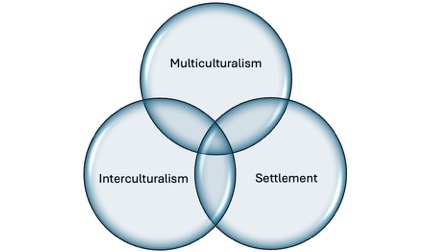
Resilient social cohesion in an immigrant society where at least half the population were either born or had at least one parent born overseas , understood in its fuller normative sense, is produced through the interaction of three distinct but interdependent processes. The policy driver needs to focus on the space where these elements come together, the underpinning for social resilience against future societal shocks.
3.1 Settlement
Settlement denotes the processes by which newcomers to a society are enabled to establish themselves as full participants in social, economic and civic life. It is foundational: without adequate settlement, the aspirations of multiculturalism and interculturalism remain unrealisable. Settlement policy encompasses practical support — language acquisition, housing, employment pathways, health and education access — but its deeper purpose is the cultivation of belonging and civic investment. When people settle well, they develop a stake in the society they have joined. When settlement is treated as a bureaucratic processing function rather than a developmental one, that stake is not formed, and the conditions for alienation are laid.
3.2 Multiculturalism
Multiculturalism, in the sense intended here, is not simply the demographic description of a diverse society. It is a normative orientation: the recognition that cultural diversity constitutes a resource for nation-building rather than an obstacle to it. A genuinely multicultural policy framework ensures that all communities have a voice in the processes that shape collective life — that they are participants in the construction of national culture, not merely its passive recipients. This distinction matters. A multiculturalism that assigns minority communities a fixed, performed identity within a framework designed by others is not recognition; it is a form of managed difference that forecloses genuine participation. A multiculturalism that alienates the majority almost ensures a radicalisation to the Right, a movement of grievance and resentment.
3.3 Interculturalism
Interculturalism extends the logic of multiculturalism from recognition to engagement. Where multiculturalism affirms the value of diverse communities, interculturalism requires that those communities encounter one another — in common tasks, shared institutions, collaborative enterprises — at every level of social life. The conceptual move from multiculturalism to interculturalism is, in essence, a move from coexistence to cooperation. It is also a move from a static to a dynamic understanding of culture: cultures are not fixed essences to be preserved in separation, but living practices that are transformed through contact and exchange. The Australian policy tradition has been considerably stronger on the former than the latter.
Three foundations underpin this vision:
- Recognition — the active acknowledgment that every community’s history, contribution and experience is part of the national story. This includes, centrally, the unfinished work of truth-telling with First Nations peoples, whose marginalisation teaches all other communities that belonging in Australia is conditional.
- Mutuality — the genuine understanding that what damages one community diminishes all. Antisemitism is not ‘a Jewish problem’. Islamophobia is not ‘a Muslim problem’. Each is a corrosive agent in the shared civic life of the whole nation.
- Reciprocity — the practical reality that intercultural collaboration makes all communities more capable, more creative and more secure. Nation-building is not a zero-sum contest; it is a generative project.
Together, these three dimensions do not merely describe cohesive resilience — they describe what nation-building in a pluralist democracy requires of its institutions and its people.
Cohesive Resilience: policy focus and direction
4. The Policy Gap and Its Consequences
The conceptual framework outlined above is not, in itself, novel. It is substantially consistent with the findings of a series of government-commissioned reviews conducted over recent years, each of which has identified dimensions of this tripartite model and proposed institutional responses. The persistent failure to act on these recommendations represents a significant policy gap with measurable social costs.
The Multicultural Framework Review proposed the establishment of a national institution to build intercultural engagement, stimulate cooperation and widen public understanding. It was accepted in principle; it has not been implemented. The National Anti-Racism Strategy recommended training, education and social integration measures to address the deep structural harms of racism. It remains under consideration. The reports of the Antisemitism and Islamophobia Envoys have been received — one with greater urgency than the other, given the events of December 2025 — but neither has produced the considered systemic institutional responses their findings warrant.
The consequence is a social environment in which racism retains its structural salience, in which Jewish Australians live under conditions of fear that constrain their civic participation, and in which Muslim Australians face entrenched hostility that has not been systematically addressed. Other minority communities also suffer from the anxieties that increasing intolerance generates, often in situations that they neither understand nor respect, which they see as creating disharmony and social conflict. These are not isolated community problems. They are indicators of a failure of national social architecture. All of course are exacerbated by increasing economic pressures, which bad actors can blame on cultural difference.
5. Institutional Implications
What is required is not primarily a refinement of existing policies but a reconceptualisation of the institutional infrastructure for social cohesion through the lens of resilience. Four implications are of particular relevance for policy that responds to this framework:
- The language of policy must be reconceived. The term ‘social cohesion’ should be understood and deployed as a dynamic nation-building process — one that encompasses intercultural engagement, civic participation and community education — rather than as a condition of managed equilibrium. The goal is social resilience, built on recognition, mutuality and reciprocity. Perhaps it is time for social cohesion to be put to one side as a narrative.
- A dedicated national institution — consolidating the roles envisaged by the Multicultural Framework Review while drawing on insights of the Race Discrimination Commissioner, the Antisemitism Envoy and the Islamophobia Envoy where appropriate and practical — is necessary to coordinate the settlement, multicultural and intercultural dimensions of social resilience within a single coherent mandate. Fragmented institutional arrangements have proven insufficient. The Australian Multicultural Council, established but left effectively inactive after the Framework Review, should be charged to oversee the implementation of the Review, all of the recommendations of which the Government has accepted in principle.
- Research and evaluation capacity must be embedded in the institutional architecture. The social conditions that produce or undermine resilient cohesion are not self-evident; they require sustained empirical attention and the capacity to translate evidence into responsive policy.
- Community advisory pathways must be structurally genuine — reflecting the diversity of Australia by culture, language, age, gender, disability and place — if the framework is to produce the forms of participation and belonging its theory requires. They must invite and support the participation of Australians from every background in a common purpose of nation building.
6. Conclusion
Australia has the conceptual resources to build a genuinely cohesive and resilient multicultural society. This is a major nation building challenge. It has a body of policy analysis — produced by its own review processes — that identifies the mechanisms through which resilient cohesion is built. What it has lacked is the institutional will to act on that analysis with the seriousness and urgency it demands.
The three interlocking processes of settlement, multiculturalism and interculturalism are not competing policy priorities. They are mutually constitutive: each depends on and reinforces the others, and their convergence is the condition of the cohesive social resilience that all three serve. This analytical lens can help clarify the next steps and the range of issues that must be addressed if the current crisis is not to deepen and future shocks become even less amenable to effective public responses.
Key Sources and Related Reviews
- Multicultural Framework Review (Australian Government, 2023)
- National Anti-Racism Strategy (Australian Human Rights Commission)
- Report of the Antisemitism Envoy (Australian Government, 2025)
- Report of the Islamophobia Envoy (Australian Government, 2025)
- Royal Commission on Antisemitism and Social Cohesion, Terms of Reference — Reference (d): Social Cohesion

