ABC Radio National Life Matters ( 29 November 2012) asked me to discuss the implications of my The Conversation provocation piece (republished here) (27 November 2012) on asylum seekers and why the Government and Opposition cannot “win” the games they are playing (with each other or with the world of refugees and global conflicts). The link to the ABC is here.
Category: Uncategorized
The Conversation: Licensing hate: the possible consequences of Abbott’s racial vilification changes
As politics heightens in the decreasing count down to the 2013 Federal election, the opposition is laying its cards on the table. Always on the cards since the Institute for Public Affairs, a right-wing think tank, began a fund-raising campaign for Andrew Bolt in defense of his racial vilification case, Coalition Leader Tony Abbott has delivered to his ideological heartland with a commitment to remove key elements of Section 18C of the Race Discrimination Act (RDA).
Section 18C, known as the racial vilification provision, was introduced in 1996 with opposition agreement in the dying days of the Keating government to make race hate speech unlawful (not illegal). Ever since 1966 when the Holt government signed onto the International Convention for the Elimination of All Forms of Racial Discrimination (ICERD) while filing a reservation on Article 4 (the outlawing of race hate speech), the position of vilifying speech on the Australian political agenda has been contentious and often murky.
The states and the Commonwealth have overlapping jurisdiction, and civil and criminal laws apply in differing ways in different states. It is a mess, and one that the Commonwealth alone cannot clean up.
The specific Commonwealth legislation requires the offended party (who has to be able to show that they are offended, vilified etc.) to seek conciliation with the offending party through the Australian Human Rights Commission (AHRC).
The AHRC cannot act on its own bat in the public interest against racist materials. Only if no agreement can be reached does the AHRC declare it cannot conciliate and refers the case to the Federal Court for arbitration. When Andrew Bolt and the Herald Sun told Pat Eatock and her Aboriginal colleagues who sought conciliation to get lost, they had no other recourse but seek a court judgement.

Once they started down the RDA path (with little likelihood of anything other than an apology and costs), they had to put aside any common law actions for Mr Abbott’s preferred option of defamation (with the potential for serious damages).
Under the headline “Freedom Wars”, Abbott portrayed himself as a crusader facing the Saracens in the Holy Land. (Note, for hyperbolists, a war for freedom is being fought in Syria, not Australia).
He went on to argue that “Freedom of speech empowers Christians, Muslims, Jews, …. everyone and anyone publicly to affirm whatever it is that is important to their identity.”
True; but Section 18C only restrains them from saying anything they wish about each other, if what is important to them depends on discourses of vilification.
In making his attack on government plans to “regulate” the news media, Mr Abbott argued: “The more powerful people are, the more important the presumption must be that less powerful people should be able to say exactly what they think of them”.
Given this logic, the converse should also hold – “the less powerful people are, the more important the presumption that more powerful people should not be able to say exactly what they think of them”.
Abbott’s initiative, licensing as it does people who wish to have no limit on their opportunities “to offend, insult, humiliate or intimidate”, has the apparent full support of his communications spokesperson Malcolm Turnbull. Turnbull’s office told The Conversation that Turnbull was “fully behind the statement” and that he had previewed and approved it.
When John Howard managed to alienate much of the Asian and Muslim communities of Sydney with his perceived support for Pauline Hanson, it took the Liberals under Barry O’Farrell many years to draw them back towards the Coalition. It paid off as the March 2011 state election demonstrated.

Yet Mr Abbott seems to have decided to potentially alienate these same groups once more. He has offered the added bonus of the Jewish community, the backbone of Turnbull’s Wentworth electorate, who have been the main users of 18C against Holocaust deniers, anti-Semites and racist agitators.
In the Executive Council of Australian Jewry submissions to the Attorney General Roxon’s consolidation review of human rights legislation, and to Race Discrimination Commissioner Helen Szoke’s Anti-Racism strategy, the ECAJ has pointed to the rising waves of anti-Semitism in Australia, the use of the internet for the dissemination of racist propaganda, and the insufficiency of Commonwealth legislation as it stands.
The government’s consolidation process appears rather disconnected and unfocused, with major problems still evident; a significant worry was that 18C would be dissolved behind a word-wall of obfuscation.
However, in response to Abbott’s speech, Roxon has said that the consolidated human rights legislation will be raised to the “highest possible standard”.
However her government recently withdrew its planned accession to the European Cybercrime Optional Protocol on Cyberracism, despite clear evidence Australia’s current regimes were inadequate, suggesting that the standards would not be quite as high as many might have hoped.
While Abbott’s speech is clearly a pay-off to the IPA, it also appears as a double-wedge: it places Turnbull in an invidious situation with his own constituency, and it seeks to wedge the government on freedom of speech issues just as the regulation of media debate reaches the boil. It may or may not represent his own viewpoint. It is also not clear whether this is a core promise, or simply rising chatter directed towards the hard edge of the conservative support.

Removing Section 18C without any replacement will open Australia to an even more thorough critique than that offered in 2011 by the United Nations Human Rights Committee. Of course, as under the Howard government, an Abbott government may well tell the UN to butt out.
What the IPA speech does is to direct public attention to what the rhetoric and the reality of human rights would look like under a returned Coalition government, with Senator Brandis as the potential Attorney General.
This is not something we’ve really seen displayed, and it adds an important dimension to the emerging Australian future being planned by the opposition.
Andrew Jakubowicz receives funding from the ARC for a project on Cyber-racism and Community Resilience (CRACR).

This article was originally published at The Conversation.
Read the original article.
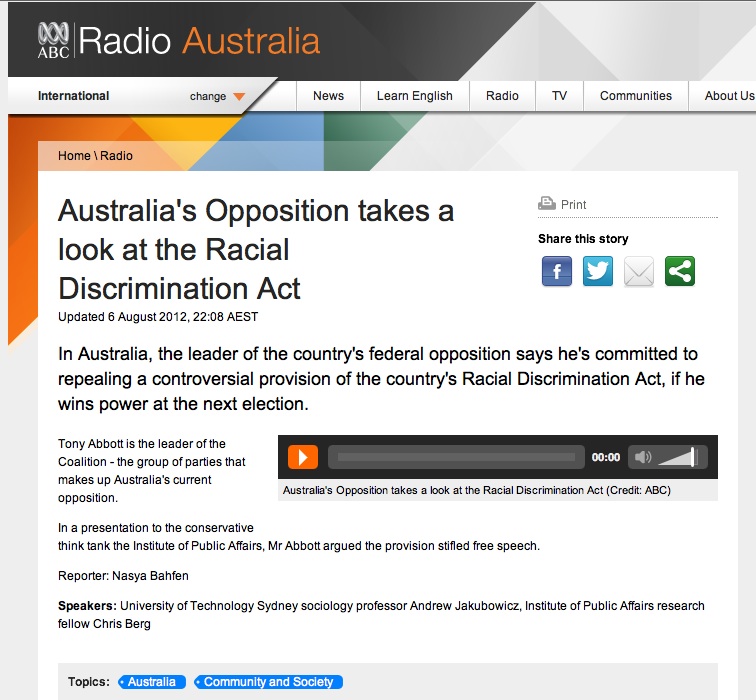
Andrew Jakubowicz UTS and Chris Berg IPA debate Tony Abbott’s pledge to repeal RDA Section 18C on racial vilification
New Migration Council to advocate for a bigger Australia
The announcement of the formation of a Migration Council of Australia and its launch by the Governor General on August 1, confirmed by Department of Immigration and Citizenship official Gary Fleming at the Settlement Council of Australia conference in Adelaide in late June, marks a critical juncture in population and immigration policy.
The Council will operate as a non-government organisation, with its own board, and look more like the Settlement Council of Australia or the Australian Multicultural Foundation, than the government’s own and somewhat tame Australian Multicultural Council. Hopefully it will not be confused with the migration agents’ lobby, the Migration Institute of Australia. While it is independent of the Government, it is likely that the new body will fit snugly with the pro-migration wings of the both the major poltiical parties.
The MCA wants to find a new space to assert the importance of migration and effective settlement, and has brought together some heavy hitters to make this happen. Headed by Peter Scanlon (ex Patricks Chair) – and bringing together Business Council of Australia chair Tony Shepherd, Australia Post head Ahmed Fahour, Ethnic Communities Federation chair Pino Migliorino, Adult Migrant Education Victoria head Catherine Scarth and a number of others – the organisation seeks to build a bridge between those with an economic interest in a big Australia, and those with a social interest in a fair Australia.
Scanlon has been a key figure in building an information base about immigration and settlement through his Foundation’s financial support for the Monash study of social attitudes to immigration, diversity and levels of social cohesion. His leadership support, both political and financial, is seen to be critical for the effectiveness of the MCA. Scanlon has history as a strong advocate for his causes: in the Elders IXL struggle for BHP in the 1980s, with Patricks, and now with the Garvin Institute and the Scanlon Foundation. He is also a major real estate developer and will come under scrutiny for how this new lobby group might create benefits for his commercial interests.
The board has appointed Multicultural Minister Kate Lundy’s former advisor – the well connected and politically astute Carla Wilshire – to the CEO role, a challenging post which confronts the opportunities and pitfalls of the current immigration scene.
Immigration vs small Australia
There is growing community acceptance that a moderately bigger Australia is beneficial for the economy. Nevertheless, hostilities are also evident, and there is enormous distress over refugee and asylum seeker policy.
Meanwhile, the environmental sustainability debate has frozen over since the hysteria of 2010 gave way to the astonishment of 2011, with the immigration curve’s steep rise suddenly levelling out and then coasting down again.
Even so, the small Australia lobby(led by Foreign Minister Bob Carr and his mate Dick Smith) has not let up its push, and the Greens and the environmental lobby are still hammering away at reducing population growth. In the shadows behind them can be seen a collection of anti-immigrant and nativist activists.
Into the mix step Gina Rinehart and her Western Australian mining mates, whose deal with Immigration Minister Chris Bowen over 8,000 new jobs including nearly 2,000 457 visa recruits, hit a stumbling block with the unions. The unions, of course, are worried at the rapid destruction of industrial jobs in the east, and seem to have opted for a tried and true anti-immigration reaction.
Government challenges
The creation of the Council also highlights two key failures of the government:
1. There will clearly not be a statutory migration council, which would place migration and settlement planning at the heart of government, rather than palmed off to a civil society lobby group. The immigration councils of the post-war period did much to cement support for the immigration program among potentially conflicting interests; and
2. There will not be a government migration research institute (the Bureau of Immigration, Multicultural and Population Research, abolished by John Howard, played a crucial role in providing research-based information for the policy debates of the 1980s and early 1990s, a major hole in current policy).
The decision to take the issue to the NGO sector provides an insight to the problem within government in handling migration issues.
Minister Bowen has very little purchase with Gillard, and seems unable or unwilling to communicate with her on wider issues, as the foreign workers issue in the mining industry reveals.
At the same time Lundy, who’s from a very different faction, seems to have limited purchase with Bowen. She has been unable to increase the funding of her settlement and multicultural responsibilities, one of the reasons the settlement sector fears the creation of the Migration Council (which is rumoured will be funded from money now allocated to the Settlement Council).
Meanwhile, Department of Immigration and Citizenship head Andrew Metcalfe (currently on leave but also prospectively on the board of the MCA), warned last year that the current immigration mess would produce major social unrest in Australia’s cities in coming years, a key problem for settlement. Governments have demonstrated their incapacity to resolve the many impasses that immigration highlights. At least two state governments, not consulted in the MCA development, remain wary about the potential impact of a new lobby.
On the sidelines, a joint federal parliamentary committee on migration will be reporting in August. It will be faced with reconciling the mass of public submissions (more than 500) that range from Anders Breivik-type White Power mania, to arguments from academics and others that the current policy environment is a logic- and information-free zone that requires major re-vitalisation, and a reassertion of social justice and human rights goals.
Migration Council’s first steps
The MCA has pulled some resources with it, but it will need a great deal of money and a fine feel for building community relations, if it’s not to alienate existing organisations or dry up its sources of meagre government support.
The Council will need to build a cross-party and community consensus on the need for continuing immigration and an expansion of its 457 component. But it needs to be wary that a rise in 457 visas sought by the mining lobby and other pro-growth advocates could increase already well-identified social problems of exploitation and isolation.
When you consider the inept and confused way the federal government has announced new immigration strategies, including the enterprise agreements with Rinehart, it seems that a broadly-based and responsive group concerned with ensuring rational, evidence-based policy, will have a critical role to play.
Even so, the MCA will have its work cut out to navigate the tensions and produce outcomes that work both for its economic and social backers.

