Cronulla riots: 10 years what have we learned

See on SBS Page
In December 2005 I was discussing inter-group issues with a Palestinian sociologist at Haifa University; reflecting on the breaking news from Cronulla, he suggested I might like to stay in Israel for a while. News of the conflict travelled far and fast.

Who has learned what from those violent days in that hot summer? The build up at Cronulla was set against a year of growing tension, with news reports of gang rapes, beach-front violence, and increasing racially-charged stirring by shock-jock Alan Jones.

Despite the denials of PM Howard, Cronulla was a quintessential modern Australian mess.

The key participants in those events and their aftermath are drawn from every part of Australian society – the coastal communities with their own histories of sexism and violence, the western suburban communities of the children of the refugees of a generation before, the conservative heartland of the Liberals, and the knock about branch stacking of the Labor Right. Despite the denials of PM Howard, Cronulla was a quintessential modern Australian mess.

When Strike Force Neil later reported to the NSW Cabinet on the debacle of the day and the retaliation raids in the aftermath, it revealed a police and government uncaring and unprepared, with no intelligence of what was happening in the communities, and no capacity to foresee and thus be forearmed or even forewarned, and no public presence in the ongoing debate.

The police learned a lot from Cronulla: they became militarised, they modernised with riot squads, body armour and anti-personnel ordinance. Their command and control structures were reinvigorated with a much greater planning and response capacity. Most importantly but not sufficiently, they realised that community relations and engagement would be crucial. While a battle raged in the upper echelons of the NSW Police over corruption and competence, the first steps were made, albeit on tottering ankles, to lay down long term positive relations with some of the communities. Ironically the relations are today better with the Muslim communities, from which most intelligence now comes, than their non-Muslim antagonists, whose rallies on Cronulla Day will do most to stoke community apprehension and anger.

So one lesson from Cronulla that has bitten for both absolutists and white racists, has been that hate speech works for them and their causes.

The political class has learned very little. They appear not to realise that the absolutist wing of the Islamic groups need their Islamophobia to gain purchase on the apprehensions of the wider Muslim communities. Whenever a Federal minister slings off at a Muslim leader, often in an ill-considered and demeaning way, he or she adds to the evidence that absolutists use to intimidate their own communities into subservience to the Jihadist fantasy of a Caliphate.

Whenever a ministerial slam is made on a Muslim leader, the racist Right draws courage from the affirmation they see for their claims to the irremediable deviance of all Muslims. So one lesson from Cronulla that has bitten for both absolutists and white racists, has been that hate speech works for them and their causes. Reclaim Australia and the Jihadists desperately and achingly need each other; no one else does.

The Muslim communities have learned that they face two enemies. Inside Islam, they are continually harassed by extremists, who want all Muslims to turn their backs on the values of democratic Australia and to bow unthinkingly before the ideologues of Islamism. Outside Islam they confront a spreading stain of invective and hatred from non-Muslim society, occasioned by the violence of small minorities, which preach the religion of despair. This has become an excruciatingly painful impasse in which to be trapped.

Ten years after Cronulla frightened and angry non-Muslims will rally at Cronulla to “celebrate” what was in truth then not even a Phyrric victory. They will be protected and deterred by a heavy police presence, now steered by people who have studied the mistakes of the past, and the somewhat limited successes (such as the prevention of the attack on the US Consulate through Hyde Park in 2012).

Cronulla has taught us that sustained engagement, active and respectful listening, and creative involvement…remains crucial to building the trust that necessarily underpins the social capital of a cohesive society.

State politicians in NSW will be better guided by a major strategy of community engagement and social cohesion, and few if any will be allowed by their leaders and advisers to erupt into the demagoguery and rhetoric of 2005. Federal Liberal politicians, with no such strategy and an emotional imperative that seems to demand they call out to the most fearful and least rational parts of the community, will probably do so again as they have done in recent days.

Australians have moved a few steps beyond the aged supporters of 18th century France’s Ancien Regime, which had learned or forgotten nothing. Cronulla has taught us that sustained engagement, active and respectful listening, and creative involvement, enabling people to put down a stake and a place in the complex web of reciprocal social relations, remains crucial to building the trust that necessarily underpins the social capital of a cohesive society. Unfortunately those who do not want to see that trust realised are all too eager to find every opportunity to let the conflict rip.
Why Australia needs a Multiculturalism Act and why Malcolm Turnbull should deliver one.

Shorter version publlished through The Conversation, with 100+ comments (some people are scary)

When Australia’s Prime Minister Malcolm Turnbull in early November used a celebration of Australian multiculturalism  to open a speech justifying increased penalties for ever-younger potential jihadis, he made two rather profound statements. For the first time since Bob Hawke an Australian Prime Minister centred multiculturalism as a potential strength in building national security. In the same breath he demonstrated that it had failed in that task, as punitive sanctions were required because by implication multiculturalism had not been successful enough.

The reason for the failure was left to us to discern. I argue that the key reason for multiculturalism not providing “the cement for all Australians” that PM Howard had derided in 1988, lies in the refusal of national government after government since Hawke to legislate for its application to public life. Unlike the major states that have had no problem with multicultural legislation, the Commonwealth has surrendered the territory that effective multicultural policy should occupy, by pre-emptive buckling to nativist Right wing populists, and more recently, to jihadist ideologues with no interest in Australia. Continue reading “Why Australia needs a Multiculturalism Act and why Malcolm Turnbull should deliver one.”

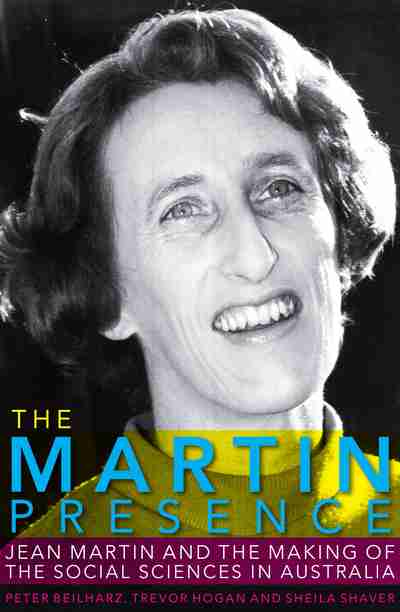
Notes on launching “The Martin Presence”

The Martin Presence: Jean Martin and the Making of the Social Sciences in Australia
Peter Beilharz, Trevor Hogan, Sheila Shaver

Paperback | Jun 2015 | UNSW Press | 9781742232164 | 304pp | 234x153mm | Stocked item (plenty) | GEN | AUD$39.99, NZD$47.99
Digital (EPUB) | Jun 2015 | UNSW Press | Stocked item | GEN

Launched by Andrew Jakubowicz at Gleebooks Sydney 18 June 2015

  • I recognise the Gadigal people of the Eora nation. Great honour to be asked to launch the book by . On reflection it may be that there are few enough of us around that knew her and still have held onto the memory. I am reminded of my own somewhat inglorious earlier years by the authors’ account of internal struggles over the control of the sociology journal 45 years ago. Terrifyingly, it was just a moment ago.
  • A week ago in Warsaw in the palace of culture I was engaged with Polish scholars on the future of multiculturalism. Next was two days of refugee survival conferencing during and after WW2. The qualities of the dialogue in both cases had many Martinesque qualities.

Continue reading “Notes on launching “The Martin Presence””

Seeking refuge in a sea of troubles

During September, while Europe was experiencing the ever-intensifying movement of populations from the Middle East and Africa fleeing natural and human calamities, I was on a field trip to China. My contact with the crisis came from the constantly recycling footage on BBC and CNN, topped up with China Daily reports, and occasionally an online hit from the ABC.

Lecture poster with author, Andrew Jakubowicz Tsinghua Sept 2015

Ironically my research was focussed on a group of Polish Jews who in August 1941 were shipped by Japanese authorities from Kobe, where their flight to the asylum had been halted by the Japanese invasion of Indo-China and the consequent cessation of shipping contact, to Japanese-occupied Shanghai. In Shanghai the Japanese in control of the Hongkew area where most of the 1938/39 German and Austrian refugees already lived, refused to accept the Poles, labelling them undesirables, while the Shanghai Municipal Council, still under effectively British dominance, also tried to withstand their arrival. The local Jewish refugee committee, which had crammed hundreds of the fraught arrivals into a synagogue near the Bund, came up with an inventive solution. They reported the Synagogue to the Council as an over-crowded and unsanitary dwelling, that required immediate closure, with its residents having therefore to be housed by the SMC elsewhere.

Events moved on, though here is not the place for the full story; however the dynamic of apprehension, expulsion and rejection by authorities, inventiveness in pursuit of survival by the refugees, and hand-wringing by bystanders, suggests societal alarm in the face of such events repeats well-known rituals, despite the lessons of history.

In major cities in China such as Harbin and Beijing, I was invited to give lectures to large classes of undergraduate students on issues associated with cultural diversity, refugees, and identity. At the conclusion there was question time, which usually went straight to the point, querying Australia’s policies on refugees, Indigenous issues, and racism. (One of these question times took place just as my iPhone loaded the story from Sydney of a Chinese Australian woman who had been harassed and vilified on a bus.) The students typically found it bemusing that Australia should claim an international persona as a human rights champion, while so clearly condemning hundreds if not thousands of people to lives of poverty, immiseraton and hopelessness.

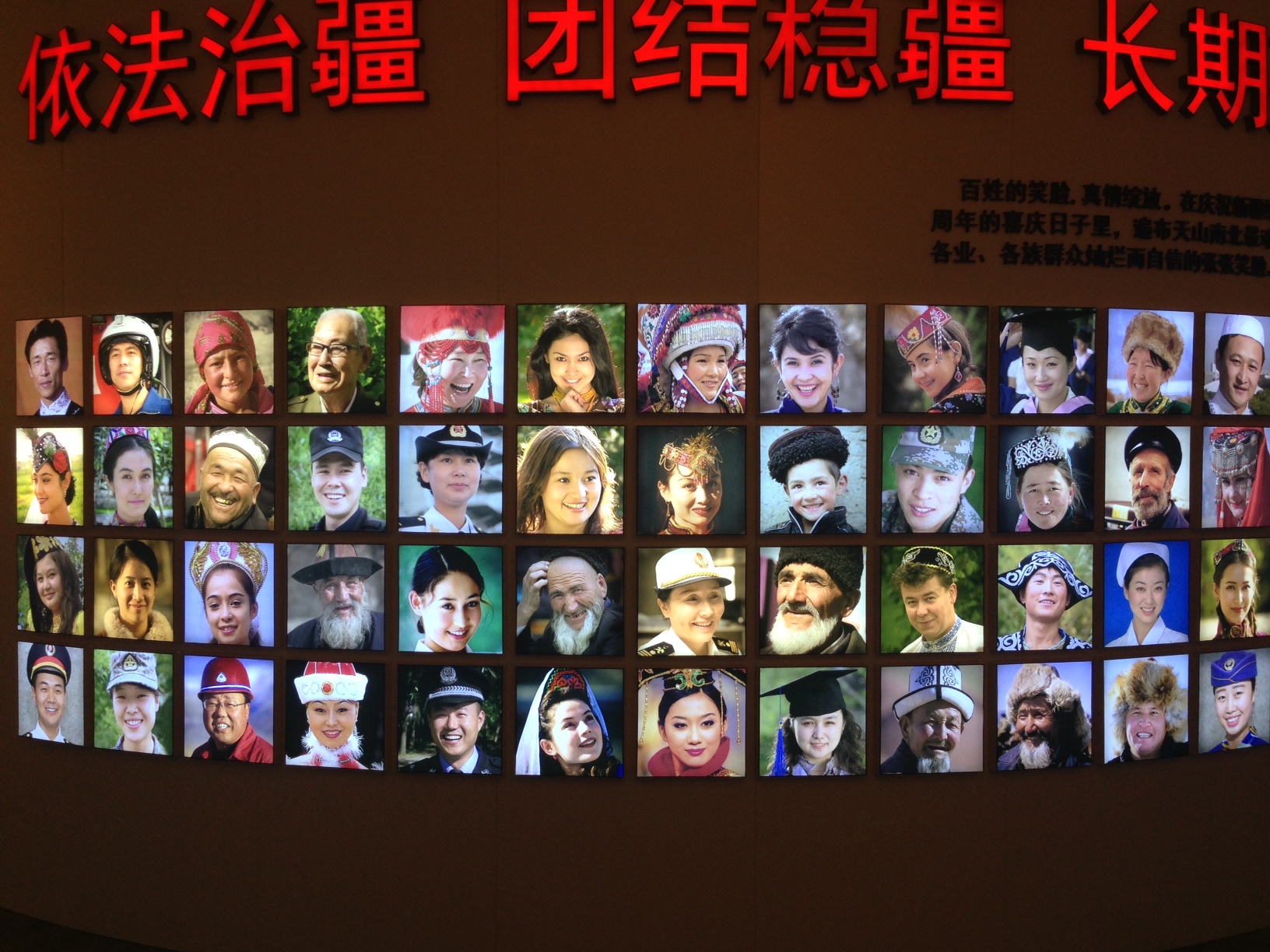
Diversity and Symbolism, Xinjiang Exhibition 60th Anniversary of PRC, Beijing, September 2015

Answering a question with a question, I asked the students whether China should accept Syrian refugees, and if so, how many? China after all is not without blood on its hands, playing a crucial role in the trans-Asian anti-Sunni alliance that links policies against extremism in Xinjiang, with expanding collaboration with a now “cleansed” Iran, and close links with regimes in former Soviet Turkestan, and of course with the Russians, supporting the Assad regime itself. Meanwhile, China has indicated a desire for and the acceptance of a responsibility to step up to international obligations in order to claim the legitimacy and influence it seeks at a global level.

With the refugee crisis in Europe reaching a crescendo and no real end in sight, despite Putin’s proposal for a new alliance of anti-ISIS forces, China as a signatory to the Refugee Convention, ought to be demonstrating a humanitarian concern. After all in 1941, the Chinese government had been one of the few governments globally to be actively seeking to rescue Jewish escapees from the Holocaust.

The first time I asked this question, how many Syrians for China, I was not sure if I had done something weirdly culturally inappropriate. It was as though the question hadn’t been asked. In a room of maybe three hundred students the response was silence. Not one student thought aloud that China should play a role; moreover it appeared that not one student had even previously considered the question as relevant.

I was reminded of the wonderful contribution to world refugee history made by the accidental Australian delegate to the Evian refugee conference of 1938, trade minister Col. White MP (himself something of a hero from a post World War One role as one of the Australian military officers who tried to aid the survival of Armenian victims of the Ottoman exterminations). White reflected on the push by the USA to have the world step up to its demands to find homes for hundreds of thousands of Jews being expelled from the Third Reich: Australia, he opined, was not a country with a race problem, and thought it unwise to import one.

Pushing the students to get a more considered opinion than the possible shared wariness of being seen as an outsider on something on which the Party hadn’t yet issued a public opinion edict, I posited a scenario of Syrians arriving at the Xinjiang border from one of the ‘Stans, seeking refuge among the Sunni Uighur communities around Kashgar (unlikely though that may be). Still nothing much more, than “Why would we?” Then one brave soul offered this insight, “the Party would round them up in the night as they crossed the border, and send them back to where they came from”. At least that got a reaction from some young women at the back of the room, who whispered in astonishment “you can’t send them back…”

Klaus Neumann in his June 2015 book Across the Seas: Australia’s Response to Refugees: A History (reviewed here http://www.sydneyreviewofbooks.com/across-the-seas-klaus-neumann/) demonstrated that refugee policy in Australia has always been fashioned firstly by their domestic political interests as perceived by the ruling political party, channelling prejudice and patronage in equal parts. This order of priority was apparent at Evian in 1938, again in 1946-47 when the Shanghai Jewish refugees sought final protection in Australia, during the Bosnian war in the 1990s when Howard in the face of rising and perverse public opinion blindsided Ruddock, who was desperately trying to avoid accepting any Muslims from Yugoslavia, by agreeing to a short-term group, and once more in recent weeks when 12,000 Syrians (Christians, please, and we’ll maybe add them to our yearly quota, maybe not) were accepted by Abbott in his last spasm to find a moral compass and save his job. This preferred religious gloss was an attractive addition, that almost echoed the first Polish response to European requests to take Syrians earlier this year, when the EU-proposed quota of 800 was held back to 80, all of whom would need to be Christians, and none anything other than Catholics, especially not Evangelicals (take that Scott Morrison, though Kevin Andrews would be pleased).

Forced global population movements generate the most significant ethical challenges possible – for all involved. When Homo Sapiens moved relentlessly out of Africa into Europe, along some of the same pathways being used today, their Neanderthal “hosts” barely had time to register the presence before their world began to change forever. When Phillip and his motley crew unloaded their diseases, ideologies and poisons into the biosphere of Sydney Cove in 1788, and onto the totally unsuspecting Eora people, neither knew the terminal consequences of the interaction, though Phillip at least had riding instructions to be aware of the possibilities.

With Germany set to settle one million immigrants, and Europe as a whole looking at many more, huge numbers of whom are likely to be anything but “settled” for years to come, we have turned a significant corner. The ethno-national state, once the driver for political development across the planet, now faces erosion from all sides. New empires are flexing their muscles (some even pouring concrete into oceans as they march outwards), non-state actors dominate swathes of territory across now increasingly meaningless national borders, and metropolitan kernels of former empires face multiple fragments of theirs and others’ former empires striking back. The decision to import trouble has already been well and truly swamped by the realities of the troubles to be faced.

ends