Launch The Boy on the Tricycle by Marcel Weyland

Andrew Jakubowicz  Launch 12 May 2016 at the Polish Consulate Woollahra Sydney.
 

IMG_1528.JPG
Andrew, Regina, Marcel, Veronica Sumegi (publisher), Phillip


While I have been in Marcel’s consciousness some few years more than he has been in mine, I am honoured that he has asked me, the nephew, to help launch this memory of a life well lived.

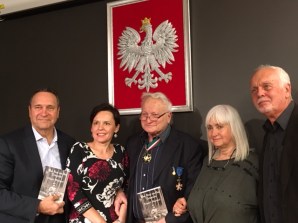
IMG_1535.JPG
Consul Regina Jurkowska, Marcel Weyland, Phillip Hinton


From my earliest memories he was part of my family world, with the trips from Bondi to the rambling mansion at Mosman, and my getting to know the line of cousins and that mysterious string of Irish relatives brought into our family through his marriage with Philippa.
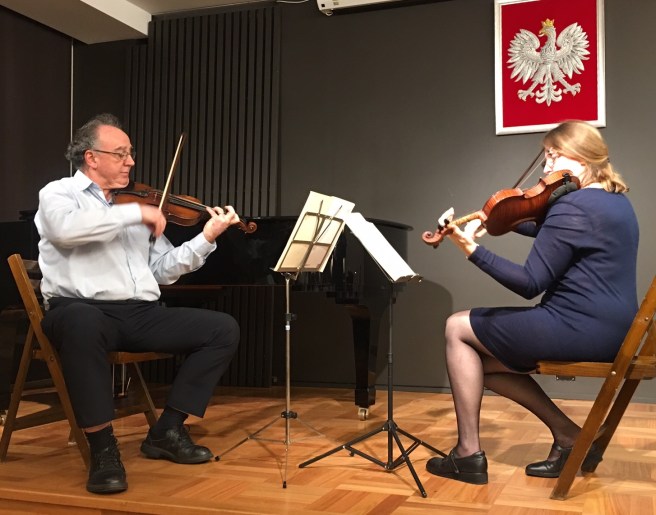
PAulJuliaLaunch2016
Paul and Julia Pokorny (daughter Marcel) play at beginning of evening

His life has trailed the history of the modern world, starting from the calm comfort of a bourgeois home in Lodz, Poland, and being completed but by no means finished now in the other bookend in Sydney, Australia, his ever spreading offsprings’ offspring melding with the children of other immigrants from all over the world.
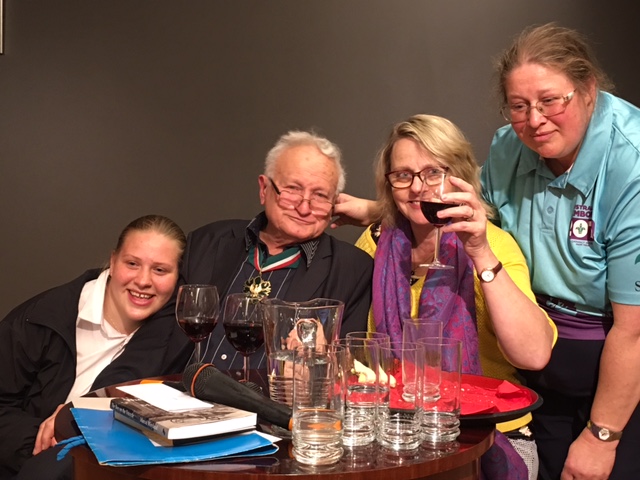
IMG_1556.JPG
En famille…

I have seen his memoir emerge at a steady pace, and watched how memory and contemporary prospect intertwine and feed on each other. In June last year some of his memoir was shared via video in progress with family, friends and interested observers at a ceremony I attended in the Synagogue in Warsaw. Then three months later, the invitation to him I had been handed there and trusted to deliver by Japanese officials, was realised as he was guest of honour at a ceremony in Kaunas Lithuania to celebrate the 75th anniversary of the role that Chiune Sugihara had played in the survival of our family. While Marcel was in Kaunas, Mara and I were in Shanghai watching a musical “The Jews of Shanghai” performed to celebrate the end of the war against Japan, which permitted him to take the final voyage to freedom in Australia.

AndrewMarcelEaglelaunch120516
The Eagle, Andrew, Marcel

This is very much Marcel’s night, and it represents another milestone in an extraordinary career that he has developed as a bridge between the many societies where his life paused in its trajectory. Born in Poland, saved firstly from the Holocaust in Lithuania by British officials representing Poland, and by a Dutch and Japanese official who was running Polish secret agents, and then a Soviet officer, then permitted to escape across the USSR, settled for a time in Kobe, Japan, then shifted unceremoniously to Shanghai, where suddenly all forward movement halted, Marcel arrived with my parents and his mother in Sydney in September 1946 where his sister Maria, greeted him. This sputtering but magical journey is only one part of a tremendous life, part luck, part courage, part adventurous imagination.


There were many moments of extraordinary luck and serendipity, which he records with a wonderfully wry style in this book.   We were discussing one of those – why and how did he get to Shanghai, last year. I wanted to know more and after the trip to Shanghai and a turn in the archives there I had even more questions. There are at least three heroes in Marcel’s story – Chiune Sugihara, the Japanese consul in Kaunas; Jan Zwartendijk, the inventive Dutch honorary consul in the same city; and the Polish Ambassador to Japan Tadeusz Romer, who was moved from Tokyo to Shanghai about the same time Marcel was shipped from Kobe to that same city.
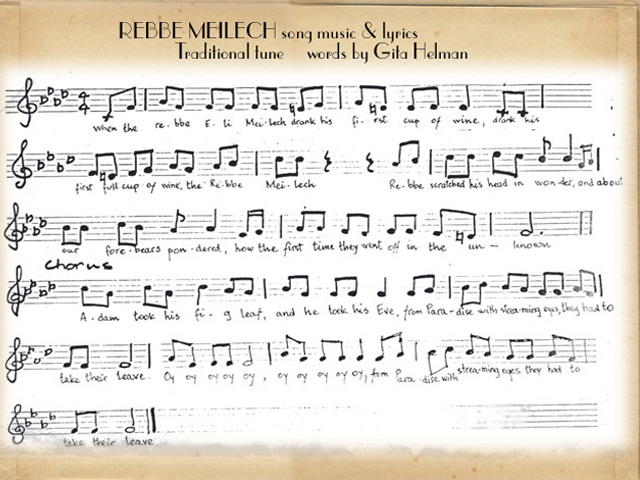
VilnaRebbeMeilichSongMusic copy
Marcel sang this song, in English (his translation), all verses at the launch: originally performed in Vilna in Polish, during winter 1940/41, in a refugee cabaret: Gila Helman perished there under the Nazis

Marcel and the family were on the last boat to Shanghai. Up until July 1941 the expectation of most of the 2000 Polish Jews who had used Sugihara and Zwartendijk papers to get to Japan, was that they would get out to North America, South America, Australia or Palestine. Maria had already secured a link to a refugee accepted by Canada, later known as Stefan Golston, serendipitously as we now know also a translator of Polish poetry. However at the end of July all shipping out of Japan to the west was halted, as was the flow of money to support the refugees from the USA. The civil authorities in Kobe decided that the final 1000 Poles had to leave, and they sent three ships to Shanghai. Our family remained in Kobe, maybe because they still hoped to get to Canada, maybe because unlike many others they were not destitute as my father worked for the local JewCom.

In Shanghai the Japanese military authorities were very unwelcoming; in their view the Polish Jews were undesirable and would not be allowed to land in Hongkew where the Jewish community had housing. The Vichy French banned entry to the French Concession. The Jewish community confronted the Shanghai Municipal Council, an international body run by British officials, and demanded they help, or they would cable Kobe and tell the refugees not to leave.

The confrontation continued – the community had housing where there was no entry allowed, and where entry was allowed they had no housing. When the third boat arrived at the end of August the passengers disembarked on the Bund and were first housed in the Museum Road synagogue.

PolandcafeRussianIMG_3310

The following day the community reported the synagogue as over crowded to the Council, demanding it find alternative accommodation. This ruse did not work but soon after the arrivals were allowed into some of the housing in Hongkew; the rabbinical students (about 300) stayed in the synagogue, and the others moved to the Jewish club in the French Concession. Marcel and our family arrived on a fourth ship that left Kobe on September 15. They were then moved to a house belonging to the Catholic church in the French Concession – we visited it again last year, preserved by the Shanghai city across the road from the Shanghai Hilton.

As the memoir notes, Marcel then tracked off to find a school, repeating an adventure from Kobe, and by October he was at the Shanghai Jewish School. Michal their father urged Maria, who had the Canadian visa, to take the last berth on a Dutch boat heading for Australia, entry arranged through Romer’s good offices. It would turn out to be the last ship out, and their expectation that Maria would do the necessary to help them also leave did not occur until June 1946.
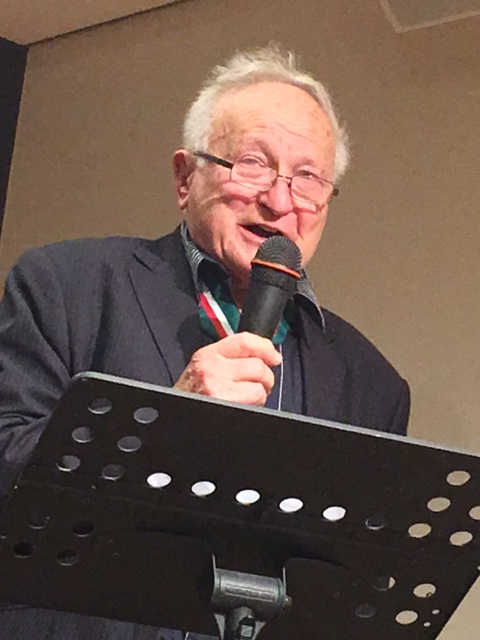
IMG_1507.JPG
The singer sings his song

In 1943 the remaining family members were ordered to move into Hongkew (The Designated Area), where they lived in a house in Dalny Road. Mara and I saw it being demolished in 2000 for the new metro station near the Jewish Refugee Museum.

I want to make short mention here of five of the Polish Jews whose lives ended in Japanese custody, when they protested the move to the Ghetto. They tried to assert that they were Polish citizens not stateless refugees: to no avail. The five had all received Sugihara visas in Lithuania in 1940; they had travelled across the USSR and found refuge in Kobe in 1941; they had been shipped to Shanghai in late 1941, two on the last ship in September. In a very real sense they were the Jews who martyred themselves for the Polish cause; their names were Josef Altminc (from Warsaw, 45 yo, JDC Vilna list 64, Sugihara list 157, Polish consulate list 1340); Berysz Abramowicz (Sugihara list 1376, Polish consulate list 1054); Aleksander Halperson (Sugihara list 370, Polish consulate list 1200); Gersz Praskier (Sugihara list 1048, Polish consulate list 1131); and Teodor Finkelstein (Sugihara 1680).

In September 1946 Marcel and his mother, with my parents, arrived by ship from Hong Kong on the SS Yochow, at Woolloomooloo. Michal had died of cancer in Shanghai in 1942. My father’s parents had perished in 1942 in the Litzmannstadt ghetto (Lodz) and at Kulmhof death camp (Chelmno) in Poland.
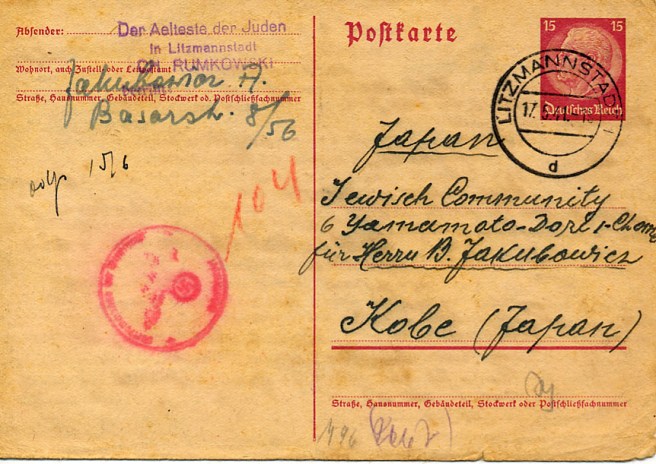
AJcardBJKobe5_41
Last contact: his father to my father, May 1941.

With great emotion and heartfelt thanks for his life and the magic that allowed him to live it, I declare the memoir of the boy on the tricycle launched, and ask Phillip Hinton to read to us from its wonderful text.
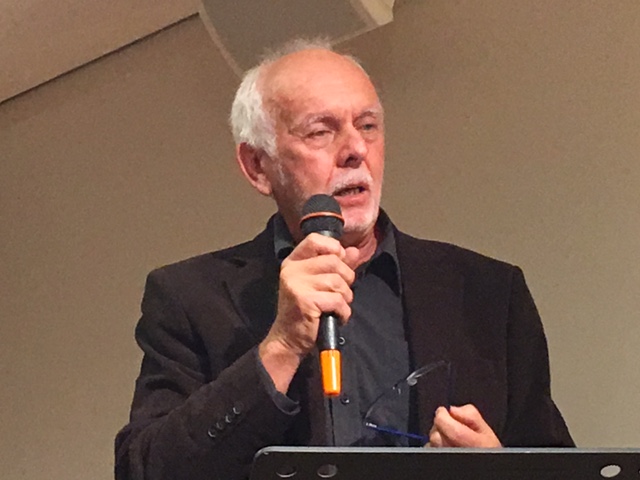
 

IMG_1501.JPG
Phillip Hinton in full flight
IMG_1511.JPG
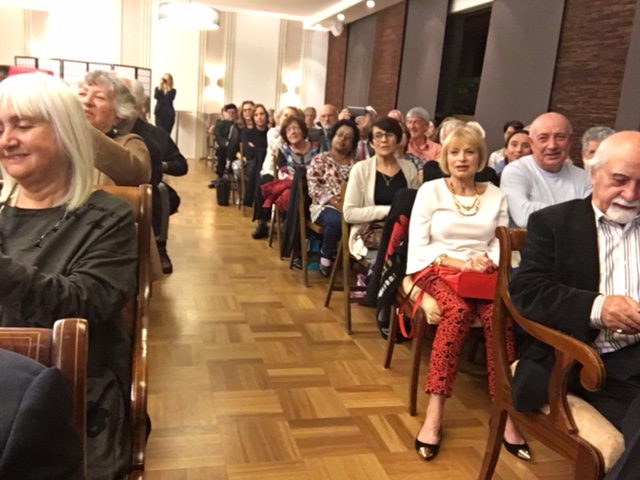
The Crowd

Election 2016: the most exciting time to be multicultural in Australia?

Andrew Jakubowicz, University of Technology Sydney

Malcolm Turnbull and his multiculturalism minister, Craig Laundy, believe Australia is the world’s most successful multicultural society. However comforting that declaration may be, the major parties have very different views on some of the hot-button issues deeply embedded in contemporary multicultural Australia.

Multicultural issues may not decide the election. But the multicultural voting make-up of many marginal electorates will play a critical part in who wins these seats.

In interviews with me, Laundy, the shadow multiculturalism minister, Michelle Rowland, and Greens leader and multicultural affairs spokesperson Richard Di Natale identified their priorities and passions within their parties’ multicultural agendas.

The big pictures

Hot-button issues include the place of Muslims in Australian society, the role of the heavily criticised Australian Multicultural Council, whether Australia should follow Canada and pass a national Multicultural Australia Act, the whiteness of mainstream Australian media, whether religious beliefs should be protected from vilification, and where “multicultural awareness” should sit in the whole of government.

The opportunities multiculturalism presents are key for minister Craig Laundy.
AAP/Mick Tsikas

For Laundy, the opportunities multiculturalism presents are key. Cultural diversity is the launching pad, for instance, into international trade under the new free trade agreements. The Chinese businesspeople of Burwood, in Sydney’s inner west, are for him the epitome of what Liberal multiculturalism can achieve. This is not a “migrant problem” perspective, but rather an “unblocking contribution” challenge.

Care issues focus on the aged. Laundy is “not aware” of any issues of accessibility around the National Disability Insurance Scheme (NDIS) for multicultural communities.

Rowland projects a more Laborist perspective. For her, the critical issue is economic participation. She agrees with Laundy about the central role of English-language acquisition but would push availability more strongly.

Rowland notes the NDIS has seriously let down multicultural communities. The more well-established ethnic communities have taken effective advantage of the aged-care program. But she says the newer communities – especially from the subcontinent – are facing crises in their elder care, especially without culturally appropriate respite care.

Labor plans to re-establish an Office of Multicultural Affairs with whole-of-government responsibilities but leave it in the Department of Social Services, with a focus on English language skills and employment. It will reintroduce the Community Capital Grant program that the Coalition stopped on winning government, and introduce a “human capital” scheme to support staffing development in the multicultural sector.

Total new expenditure over the forward estimates is about A$28 million.

Richard Di Natale and the Greens’ key multiculturalism focus is on human rights.
AAP/Lukas Coch

Di Natale has spent the longest of the three in this portfolio. He knows it and the arguments well. He is close to the thinking of the national lobby, the Federation of Ethnic Communities Councils of Australia. The Greens start with ensuring “diversity in our own team” by selecting candidates who encapsulate contemporary Australia.

The Greens’ key focus is human rights. This is demonstrated in their strong opposition to the mooted changes to Section 18C of the Racial Discrimination Act and the ending of the Migrant Community Employment Fund.

For Di Natale, the demographic changes in Australian society must be reflected in cultural changes in how government works. This would mean the aged care workforce can actually engage with ageing multicultural communities, and the NDIS recognises and remedies the under-representation of cultural diversity among those who receive its trial programs.

In close

Significant differences emerge on key issues.

Laundy does not believe in setting targets for diversity inclusion, preferring to let the market sort it out. Given the clear precedence of Australian law in all cases, as a practising Catholic, he strongly supports the freedom of communities to use religious tribunals to provide guidance for individuals in conflict. He cites Catholic Canon Law, Jewish Beth Din and Islamic Sharia as appropriate.

Laundy is opposed to extending racial vilification protection to religious vilification. He argues that religions are far stronger and don’t need it.

He is also opposed to a Multicultural Australia Act, rejecting even the option of debating it. He does not believe there is any need for a Multicultural Affairs office in the prime minister’s portfolio, nor mandated participation for cultural minorities in government advisory bodies.

Laundy accepts, however, that the Australian Multicultural Council needs serious work, with its membership changed to be far more representative.

As someone who has spoken out in defence of multiculturalism, he says:

I know the views that vilify me are those of a small minority. Most Australians like what multiculturalism has done for the country.

Reflecting on the past, he notes:

Any prime minister who doesn’t support multiculturalism does so at his own peril.

Rowland shares many of Laundy’s social values. Labor, she stresses, has no policy for a Multicultural Act, though she also points to the party’s strong defence of Section 18C, especially through the shadow attorney-general, Mark Dreyfus.

Rowland agrees that perhaps an incoming government might charge a revised Australian Multicultural Council to explore legislative options for national multicultural legislation. But it is unlikely to be an election policy, and she doesn’t have a view.

Labor’s spokesperson, Michelle Rowland, believes religious groups should play no role in any Australian legal situation.
AAP/Lukas Coch

The wider issues of diversity and representation have not been on Rowland’s radar. She admits she has never discussed with the shadow communications minister, Jason Clare, issues of diverse representation on either the ABC board or in its programming.

Rowland takes a diametrically opposed position to Laundy on where religious law sits. She believes religious groups should play no role in any Australian legal situation. For her, the law is and must remain secular – be it for Jews, Catholics or Muslims.

She is also wary of whether religious vilification should be part of the Racial Discrimination Act, flipping it to Dreyfus as his responsibility. She would, however, have the review of the Multicultural Council as a pressing issue, especially in terms of its ability to advise government on key areas such as employment, support for grassroots organisations, and the building of more community hubs.

Di Natale brings an additional spin to the debate. He points to major issues affecting elderly immigrants as the Commonwealth moves to digital delivery of information. The government, he reflects, is poorly prepared for older people who are not literate in English or often their original language, losing English skills as they age, but who are expected to have access to and use the internet.

He says:

There is a real potential these people will be left behind.

Like Laundy but unlike Rowland, the Greens are willing to ensure that culturally appropriate conflict resolution (he includes Koori courts) can be extended more widely. This includes using religious institutions as points of contact and resolution.

Structurally, the Greens are the most committed to institutional reform, such as moving multicultural affairs back into the prime minister’s department and reconstituting the Multicultural Council.

The Greens support and will promote a debate on enacting Multicultural Australia legislation to clarify rights and determine responsibilities for all Australians. This would open up a wider conversation of inclusion.

Di Natale is wary in the first instance of religious vilification legislation. He fears opponents of the Racial Discrimination Act might use the opportunity to wreck the current legislation, when so much political energy was expended.

A debate about cultural inclusion, however, would have many long-term benefits. Some might turn up in legislation. It might lead to cultural change and institutional transformation such as through social media campaigns against racism, and by resolving what the Greens see as the racism inherent in the treatment of asylum seekers.

Multicultural excitement

Where initiatives are interrogated from a perspective that incorporates cultural diversity, the policy settings look different enough to affect some people when they decide how they will vote.

The new anti-terror surveillance laws may affect some members of some communities, as may the blocking of overseas Chinese investors buying into local property, from mansions to cattle ranches.

While Labor’s initiatives are small, they do reinvigorate the capacity of communities to participate in debates about cultural diversity’s future in Australia.

The government has yet to indicate any election initiatives, other than the budget statement about extending community hubs and a long-awaited career pathways pilot for skilled migrants without local experience. These will cost $11 million over three years.

Some election sweeteners are planned. We await their release after the first fortnight of the “jobs and growth” message.

In seats like those of the main multicultural spear-carriers, such engagement may well prove crucial.

The Conversation

Andrew Jakubowicz, Professor of Sociology, University of Technology Sydney

This article was originally published on The Conversation. Read the original article.

The end of the print Herald: the view from 2011

With Greg Hywood foreshadowing the abandonment of weekday print SMH and Age editions, I am reminded of a 2011 blog post I wrote for the CQ section of SBS online. Here is the critical paragraph….  scary! And only out by one year (though it may yet all fall into place as I foretold).

With the print newspaper now effectively gone, the last hard-copy edition of the Sydney Morning Herald had been produced in 2017 for that year’s double dissolution Federal election, tablet-based multimedia communication units now carry instantaneous news updates tailored to individual pro-sumer profiles.


Persona Non Grata:Twelve minutes about Sugihara and me.

May 1 2016 Bondi, NSW   JIFF: talk to the Jewish International Film Festival audience for Courage to Care

I first wrote something about Sugihara when I was 9, in a primary school essay. I cannot remember when I didn’t know about my parents’ escape from Lodz in the first week of the Nazi invasion, and later the tragic fate of my father’s parents, murdered in the Lodz ghetto and at Chelmno, and the marvellous survival of my aunt and cousins protected in a forest sanctuary by Poles, and others hidden by nuns. They were stories told to a child, full of serendipity, of choices made, of hunches played, of disasters just avoided, or those horrendously experienced. Many of these will be revealed in detail in the autobiography of my uncle Marcel Weyland, a Sugihara survivor, which I am honoured to launch at the Polish consulate on May 12.

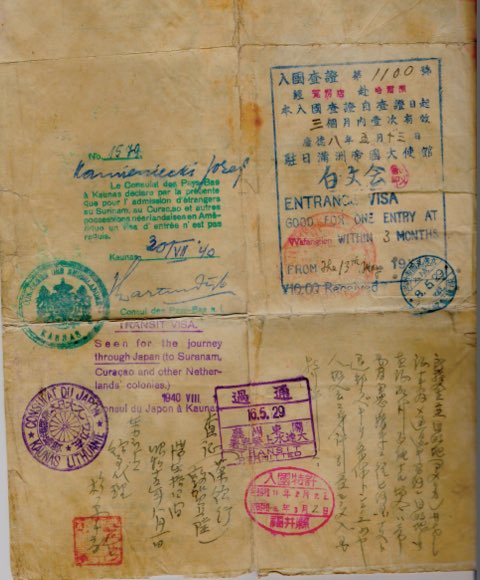
KaminieckiVisaSmall
Passport of Josef Kamieniecki, with Sugihara permit (bottom left), Zwartendijk “visa” top left, entry notes to Japan committing him to moving on (bottom right) and entry to Manchukuo (top right).

My father had told me about standing in a long line of anxious Polish Jews outside the Japanese consulate in Kaunas in the hot sun in August 1940. He and Michal Weyland my mother’s stepfather, had left the rest of the family in Vilnius and travelled the few hundred kilometres to the then capital of Lithuania. Sugihara had started issuing the permits soon after the Soviets had presented Lithuania with an ultimatum in June to accept their sovereignty. For my father it was one day before the final Soviet annexation of Lithuania.

The men wanted the Japanese permits about which they had heard, that would let their families transit Japan for somewhere else. Already when they arrived the Japanese consul Chiune Sugihara had issued over 800 permits. During the next week that number would grow by many hundreds more until the list that records these names stopped in late August at over 2100.

My parents were on the run from the Nazi occupation of Lodz in what had been Poland. By the time they left Lithuania in February 1941 under the intensifying threat of having to take Soviet citizenship, they had secured the second crucial piece of their puzzle. While they’d never met, Jan Zwartendijk and Sugihara worked in tandem.

VilnaDinnerHala
Passover, 1940, Vilnius: Halina and Maria in the centre.


Zwartendijk, a Dutch businessman, had taken on the role of consul for the Netherlands, a country already invaded by the Nazis in May: he wouldn’t be consul very long and he destroyed all the relevant documents before returning to Holland at the time Sugihara was expelled from the Lithuanian SSR. Zwartendijk devised a ruse, stating that no visa was required for entry to the Dutch colonies in the West Indies. One of the refugees who was Dutch had approached him for help: the news of his help for her and her immediate family spread rapidly.

Zwartendijk also knew that entry to Curacao was at the discretion of the Governor, and he rarely if ever gave permission. Even so this is what Sugihara needed to be able to legitimately issue the transit passes, a place to which the visa holders could transit. With this fictitious end point he could meet Tokyo’s insistence that the transit pass holders had somewhere to go, that they wouldn’t stay in Japan, and would pay for themselves. In Kobe the local Jewish community started producing guarantees of support for the refugees from Lithuania who soon would be arriving.

Sugihara was a magician. He was also a Japanese intelligence officer, running a string of Polish agents in occupied Poland, helping Polish officers and their families escape, and reporting on the Nazis preparations for the invasion of the USSR: once that happened Japan could move south.

There are many stories about how he pulled the rabbit out of the hat for the refugees, not all Poles, not all Jews, and at whose insistence. When I met his eldest son Hiroki in Los Angeles in 2000 (he died of cancer the following year) he recalled as he had for many interviewers, that he had played in the garden while watching that long line of Jews and how he had asked his father to please save them. On the wall of the consulate today, which is now the Kaunas Sugihara museum, there is a photograph of my mother, elegantly attired arm in arm with two friends, walking up the broad main street of Vilna in what must have been the summer of 1940. It would have been about the time Sugihara started issuing his permits, and the same time the Australian government was instructing its High Commission in London not to give transit permits to Polish Jews heading for Shanghai – they were “undesirable types”.

At any moment in Lithuania the NKVD might intervene or Moscow’s policy might change, especially once the family had the papers, and the Soviets were fully in charge. My father was an accountant in Poland and in Vilnius he was recruited by the Soviet occupation forces as part of the Sovietisation of private property program. I have always imagined it a cruel and bitter winter, a chiaroscuro water colour of light ebbing into darkness. My father was attached to a bakery under the impossible new economy of Stalinist state directives with production targets but no raw materials: it was dominated by central planning, subverted by the local Lithuanian baker and his family whose family livelihood had been stolen, who hated the Soviets as both Russians and communists, the Jews for being their agents (my father as a Pole and a Jew pressed two buttons, but he was outshone by the project Commissar who was Russian, Jewish, and Yiddish speaking and a communist), and reduced to chaos by the failure of the economy.

Prior to departure, when the refugees had their tickets to Moscow and Vladivostok, and their identity papers issued by the British consulate, they were called in the dead of night for the dreaded NKVD interview. On the outcome of this would hang their lives. The NKVD officer was also Jewish; while he insisted on only speaking and hearing Russian, he could overhear anyone speaking Yiddish. They shuffled up the stairs slowly edging towards their destiny. When he got there my father was offered, as had been the others, the opportunity for Soviet citizenship. Nervously he declined, perhaps making a slightly more courageous offering than he needed: “I cannot accept your invitation comrade, he said in fluent Russian, as I can have no future in the USSR. Why, asked the commissar, might that be as you have been working for the Sovietisation of private property? Well, my father said, I am not skilled in what you need, for in my past life I was a debt collector.” He was waved on, and so in the midst of a freezing February 1941 they were among the last of the Polish Jews to manage the escape. By March the Soviets closed the door, and despite pleas thousands more, some with visas, were trapped behind. In four months the Soviets would be gone, the Nazis in their place, and the majority of the 10,000 Polish Jews who had escaped to Vilna in 1939 had perished.

Not everyone who got them trusted Sugihara’s visas. Some managed to go elsewhere, often to Palestine via the USSR and Turkey. Others went back to find their families in Poland, and perished. But many took the risk, including the Mir Yeshiva, my parents and my mother’s immediate family, and a journalist Josef Kamieniecki who would later marry my aunt in Australia. The family path was through Moscow across the USSR to Vladivostok, then by boat to Tsuruga and on to Kobe. In Kobe they received support from JewCom, the American Jewish Joint Distribution committee, and the Polish government in exile through its Ambassador Tadeusz Romer, who later was expelled to Shanghai where he continued his support work. I discovered only a few weeks ago that Romer’s welfare fixer was Richard Krygier, who managed to get from Kobe to Australia before Pearl Harbour. His son Martin has become a distinguished professor of law.

How many people did Sugihara save directly – it’s a guess? He issued more than 2000 permits, but not all are recorded. Many covered whole families (some rabbinical students travelled six to a permit as a “family”) in our case two permits covered six people. Most of the holders were single men. According to JewCom in Kobe, 4600 people passed through Japan from July 1940 to November 1941. About half were German Jews, mostly not Sugihara holders; about half (2063) were Polish Jews, almost all of who were Sugihara holders. Of the Poles 500 went to the US, 190 to Canada, 250 to Palestine, 80 to Australia and 30 to New Zealand. About 110 got to South America, none to Curacao. Fifteen headed for northern China, one of who was my uncle Josef. 860 were in Shanghai as of November – together with 200 Germans from Kobe (there were 18,000 other Germans already there).

While the family hoped to keep going to somewhere else, they had Canada in mind, in September 1941 they were hustled by the Japanese onto the last ship from Kobe to Shanghai. Once there my aunt managed to get the last berth on a Dutch ship to Australia.  The rest of the family stayed in Shanghai until 1946. Michal died of cancer in 1942. The remaining four survived, along with the man who would be my godfather Aleksander Fajgenbaum, a hero of the anti-Soviet war of 1921 and the battle of Warsaw, a leader of the community and a bridge between Jewish and Christian Poles in Shanghai.

In Shanghai five of the Sugihara survivors gave their lives defending their right to be Polish citizens, rather than the stateless persons the Japanese had decided they were. Sugihara, a great friend of the Poles, would have been saddened by their tragic end, as he was for all his life an opponent of Japanese militarism.

In 1946 Maria and her then husband Gerhard Friedlander sponsored the four remaining family members from Shanghai, and they entered Australia through a brief window that the government opened; soon it would be closed in another round of Australian post-war anti-Semitism. Josef arrived in January 1947.

And the rest is history.

Or not quite: the magicians – Sugihara, Zwartendijk, and Romer – between them saved many thousands of people who have created many thousands more. In my mob the second generation comprised nine cousins; in the third generation there are twenty six cousins; and the fourtth generation is already sprouting, with a few outliers in the fifth. There has to be sixty or so of us if not more. A healthy mix we are of cultures, religions, and races.

In Japan Sugihara’s home-town of Yaotsu is applying for UNESCO world heritage status for copies of the Sugihara visas it has collected and for what they represent. One of their prize items belongs to Josef Kamieniecki, father of Prof Michael Kamm and Robert Kamm, and grandfather of Thomas and Rebecca, whose widow is Marylka Kamm nee Weyland, mother of Michael, Robert and Susan, sister of Marcel and grandmother as well of Antony, Jeremy and Elise. Josef was one of fourteen who went to Harbin from Kobe, and then south in 1942 to Shanghai.

Yochowlist2
Page from ship’s passenger manifest, SS Yochow, arriving in Sydney 1 September 1946. Most 2nd class passengers are German or Austrian Jews – there are 8 Polish Jews on this page.

Marcel fathered five children with Phillipa – Marcus, Antonia, Michaela, Julia and Lucian.

Susan is currently in Berlin, tracking down what happened to Gerhard’s family, Berliners who were seized by the Nazis, sent to Latvia, and murdered there.

They all live in our memory. Long life. L’Chaim. Arigato Sugihara-san.