Is it multiculturalism for all Australians or just some of them (us) (you)?

The Multicultural Framework Review was launched on Friday evening, June 2. It raises the question, is multicultural policy something that should be “for all Australians” as was declared in 1982, (http://www.multiculturalaustralia.edu.au/doc/auscouncilpop_1.pdf)  or just to ensure, as the announcement of the Review put it in February  “no one is left behind, and everyone feels that they truly belong”( https://www.homeaffairs.gov.au/reports-and-publications/submissions-and-discussion-papers/multicultural-framework-review ) ? The Albanese government’s Multicultural Framework Review, shepherded by Immigration and Multicultural Minister Andrew Giles,  has possibly been set the more modest goal, despite a recognition by one of its panelists, Melbourne lawyer Nyadol Nyuon, that the original multicultural policy developed fifty years ago by the ALP’s Immigration Minister Al Grassby “had a far-sighted vision of what this country could become”.

The government has identified the triggers for the review – “nine shameful years of fear-mongering and division… failures to translate vital health information during the pandemic, and government support and grant programs inaccessible to emerging migrant groups”.

The revised Terms of Reference (https://www.homeaffairs.gov.au/about-us/our-portfolios/multicultural-affairs/multicultural-framework-review note that the Review is designed to help ensure a government that works for a multicultural Australia. While it eschews a human rights perspective it does identify discrimination, systemic barriers and gender intersectionality.

While the ALP won the 2022 election with seats gained by “multicultural Australian” candidates, it also lost the most multicultural electorate of Fowler to a local candidate Dai Le who campaigned successfully against the marginalisation and abandonment of those multicultural voters during the pandemic and the parachuting in of a White candidate. With the opening up of borders and the resurgence of the issues raised by immigration, multicultural policy is once more critical to wider social well-being.

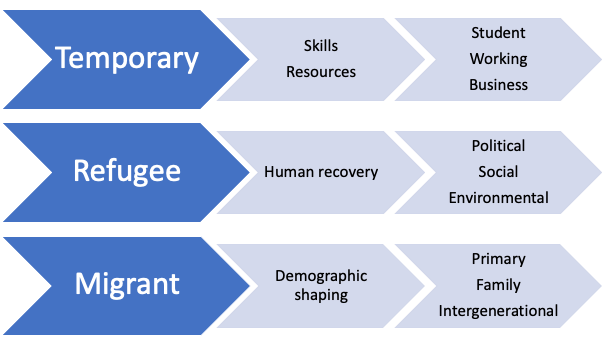
Over the past decade perhaps the biggest sleeper issue has been the massive increase in extremely insecure temporary migration, sometimes used as a subterranean route to permanent settlement. However public policy has assumed that “temporary” means “not requiring support”, so the level of services – from housing to transport to education to employment protection to health – have not factored in these supposedly temporary but very real residents. They were the ones most abandoned during the pandemic, when they were told simply to “go home” or to survive on the streets. Now they’re coming back.

There are three broadly intertwining spheres of policy that require major refreshing – multicultural policy (including language policy, intercultural relations, cultural recognition, employment policy), settlement policy (focused on new arrivals both refugees and others, including trauma recovery), and community relations (covering discrimination, anti-racism, diaspora continuity and social integration, and the all-important dimension of settler-Indigenous relations).  These are serious dimensions of governance that have been left to decay for the past generation, including during the ALP inter-regnum from 2007 to 2013.

Multicultural policy reached its apogee in 1989, with the Hawke government’s National Agenda for a Multicultural Australia. It began to decline under PM Keating who did not implement key elements of the policy. It was picked apart by PM Howard for whom multiculturalism was an anathema. Most of the damage done by Howard has been let lie.

In order to see what was lost and what now might be worth reclaiming, we can identify the targets of the Howard attack. While driven by the 1984 Blainey critique of Asian immigration and the 1988 Fitzgerald review of immigration and multiculturalism (Fitzgerald was a fervid but not successful opponent of the multicultural agenda under Hawke), the accelerator for the bonfire came from the impact of Pauline Hanson on the conservative parties in 1996.

Howard’s most critical move was the effective abolition of the Office of Multicultural Affairs, the co-ordinating policy section in Prime Minister and Cabinet. This was closely followed by the closure of the empirically-focussed Bureau for Immigration Multicultural and Population Research, condemning policy for the next generation to hyperbole based on prejudice, ignorance and ideology. In the wash the National Language Policy also dissolved, reducing the bilingual capacity of the country for decades to come. Keating had already given up on any attempt to introduce a Multicultural Act as in Canada, focusing instead on Access and Equity in government, while deeding the country the fairly toothless Racial Hatred amendments to the Race Discrimination Act (so called 18C).

How open is the the power hierarchy in Australia to non-European Australians? Addressing this issue remains a major challenge – best seen in the make-up of the High Court, the members of the Board of the ABC, the Vice Chancellors of the Universities, and the Boards of the major ASX companies (https://apo.org.au/node/140206).  

The Review will consider the Commonwealth’s activities and will be able to make recommendations on legislation, policy settings, community relations, and government services including state and local. Importantly it will consider the role of the Commonwealth as an employer, as recent studies have pointed to the under-representation of culturally and linguistically diverse groups in government at both Commonwealth and state levels. Better put, well-paid White monoglots run the services in the broad, and non-White multiglots deliver them – in greater proportions the lower the pay levels.

Unfortunately the Review is not asked to take notice of the poor state of Australia’s data on diversity and its appalling consequences, most significantly in the pandemic https://johnmenadue.com/a-tale-of-two-cities-same-pandemic/  and https://theconversation.com/we-need-to-collect-ethnicity-data-during-covid-testing-if-were-to-get-on-top-of-sydneys-outbreak-164783)but also today in terms of mortality from COVID, now particularly destructive among older “multicultural Australians”.  Neither is it asked to consider how to rebuild the depleted state of Australian research in the area, a central recommendation (at page 123) of the last ALP-led parliamentary committee review of multicultural policies in 2013(https://www.aph.gov.au/parliamentary_business/committees/house_of_representatives_committees?url=mig/multiculturalism/report.htm)  (and totally rejected by the incoming Abbott government).

The Panel chair Dr Bulent Hass Dellal, is well-blooded in these debates. He has held to a sensible course as a government advisor throughout the Abbott/Turnbull/Morrison period, and also has the confidence of the new government. Interestingly Giles has chosen two Victorians and a Queenslander for his team, leaving NSW to two people on the Reference group, with someone from Tasmania, South Australia and Western Australia.

There are no First Nations people, or people with mixed First Nations and non-Anglo heritage, though they will be invited to contribute their perspectives. As the Voice debate has shown,  multicultural Australia wants to engage with the Indigenous peoples (https://theconversation.com/will-multicultural-australians-support-the-voice-the-success-of-the-referendum-may-hinge-on-it-199304) .

The government has appointed no academic researchers to either the panel or the reference group, though Queensland’s Christine Castley is a former Deputy Director General of Premier and Cabinet, a Board member of the University of Queensland Institute for Social Science Research, and currently CEO of Multicultural Australia, a service delivery conglomerate heavily funded by the government.

From the perspective of Australia’s knowledge communities (identified in the Review as experts to be consulted) with an interest in cultural and linguistic diversity, and what the Diversity Council of Australia now refers to as “racialised marginalisation”, the commencement of the Review is disappointing. The absence of issues about data (which are currently focussing the minds of the Australian Bureau of Statistics in preparation for the next Census (https://consult.abs.gov.au/census/2026-census-topic-consultation/) ), the complete exclusion of the research structure issues, and the small passageway left open for consideration of an Australian Multicultural Act (one is already on the Senate table from the Greens dating back to 2017) and agency associated with the Department of Prime Minister and Cabinet, are not comforting signs of recognition of the scope that needs to be addressed.

Most unfortunately this Review is being sponsored by a junior Home Affairs Minister. In previous times multicultural policy was thought important enough to have the support and imprimatur of the Prime Minister – be it Malcolm Fraser or Bob Hawke. Not so now.

Fateful choices – challenges for a multicultural Australia

Dor Akech Achiek. (on left) with NSP group members and author

Fateful choices – challenges for a multicultural Australia

Andrew Jakubowicz
Emeritus Professor and Consultant Sociologist Presentation to NSP
Bankstown 8 December 2022

Jakubowicz and Ho 2013

  • Representation – cultural and political
  • Recognition – national multicultural legislation and institutions and protections and opportunities
  • Research – establishing a national network for the systematic and participatory creation, dissemination and contestation of knowledge

  • Current political context
  • • Giles May 2022:
  • • Multicultural Framework Review
  • • Standards for Measuring Diversity
  • • Digital Inclusion Strategy
  • • Support for CALD small business and entrepreneurship • Increase frontline multilingual staff
  • • Giles October 2022 National Ministers • National anti-racism framework
  • • Census data and diversity
  • • Tailored communication in public health

Rethinking

  • Parkinson/Howe/Azarias review – Migration System for the Future
  • Internal ABS etc data review framed by new capacity associated with MADIP knowledge, and its SWOT
  • CRISP – a community settlement pilot (shades of Good Neighbour Council?)\ training community groups
  • Multicultural Framework review – forthcoming?
  • DCA et al (including Giles) “Bring back race” (Black Lives matter, not only racism) – driven by African Australian concerns about marginalization on basis of physiognomy

Immediate realities

  • Governments’ COVID policies now directly and increasingly contributing to the deaths of thousands of older migrants (death rates in some groups X3+ greater than average) as they have since the onset
  • Data exists on these issues but governments are reluctant to use it or ensure better data, even though the issues are clearly understood. Hostility to knowledge about diversity, difference and discrimination. Resistance to two-way communication between diverse communities and government, preference for top-down flow of instruction
  • Gig economy has become a site for the super-exploitation of younger CALD workers (like a reshaping of secondary labour market of fifty years ago)
  • • Australia remains an ethnocracy with hierarchy of power secured by charter communities in their interest; yet understructure of Australia in reality is already heavily affected by cultural difference and perspectives
  • • Dreyfus 7 Nov 22 “Australia’s continued success as a multicultural nation must include an ongoing commitment to addressing racism,” Cyber racism is dramatically expanding despite attempts to constrain its spread – recognised by HRC and central to challenges of new anti-racism strategy. Cyber racism strategy seems to be ineffective.
  • • Pressing importance of intersectionality (gender, disability, age, sexuality) as a policy orientation and a data requirement, yet lack of investment in its development

Settlement process – realise skills and support fulfilment of aspirations

Challenges for a multicultural nation

  • Power and representation -> Ly Ly Lim focus on who rules and administers the nation
  • National institutionalization -> the Multicultural Act issue (the elephant in the room?)
  • Knowledge and prejudice -> how to build a national conversation based on evidence
  • Culture and diversity -> who tells our stories

Barriers to articulating and pursuing an aspiration freedom-based future
• Reluctance to share or transfer power outside the clan

• Reluctance to legitimize wider and more complex narratives of being Australian

• Reluctance to authorize new knowledge and perspectives __________
Advancing on these fronts is possible, feasible but difficult.

Moving on from White Australia: Election 2022?

Despite years of critique the Australian national parliament has been overwhelmingly White and massively male, unlike the country as a whole. But something changed at the 2022 election – most clearly around racism and sexism. How might this play out in the negotiations to come?

The Whitlam government supposedly ended the White Australia policy in 1973. For fifty years though, White Australia has hung on in the elite structures –Commonwealth cabinets, the High Court and the ABC Board as examples, even while changing at state and especially local levels. Prior to the 2019 election I argued that we would realise down the track that “Election 2019 was the last White Australia election, in which Euro-Australians dominated the parliamentary seats and both major party leaderships, and where xenophobia was the insistent leitmotif of the Right“. If this election marks an ending for White Australia we would expect to see change in voting, representation and policy.

Just before the election the BBC asked why the Australian Parliament was so White (and male). Sydney Policy Lab director Prof Tim Soutphomassane noted recently that “a celebration of cultural diversity has never been accompanied by a sharing of Anglo-Celtic institutional power”. Peter Khalil, an ALP MP , said in November last year that Australian politics was still swamped by an “Anglo Boys club”. Opting to describe himself as one of the 21% of the population who were NIPOCs (non-Indigenous people of colour) he reflected on years of racism and marginalisation he had experienced and witnessed inside the ALP and outside.

At the 2022 election the trajectories of change differed from each other along almost every conceivable parameter that was not old White male: middle aged well off White women took the elite Liberal urban seats from men. Younger people of colour, usually women, took many of the new Labor seats. Smart mainly young White people took the seats that were turning Green. White Australia was fragmenting along race and gender fault lines. The LNP was left with almost only older White guys in the House.

Voting

The election demonstrated the salience of specific ethnicity in contributing to voter-decisions in many seats, while the more general concern about rising racism played out for a more diverse electorate. “The Chinese vote” has been a focus for interest with many newspaper articles reflecting on the impact of the bellicose rhetoric of the LNP towards China and its impact on the “safety” that Chinese-ancestry voters felt with the conservatives. The Tally Room blog has argued that there was a significant shift towards the ALP (or better put, away from the Liberals) in electorates where the China-ancestry vote was significant. Where the opportunity existed for a potentially-successful Asian or Chinese candidate for the ALP, they were usually successful.

In Fowler, which is a very multicultural electorate with a large Vietnamese community (many with Chinese ethnicity) where the ALP ran the seemingly-resented candidate Kristina Keneally, the ALP vote dropped by nearly 19%. The local Independent Dai Le picked up all nearly all those previously ALP votes, while also taking nearly all the votes that left the Liberals (13%). The Senate vote in Fowler for the ALP also dropped significantly (8%) from 2019, while the Liberal vote rose slightly. In effect the ALP’s safest seat in NSW most likely cost the Party a secure majority.

The key electorates where an apparent anti-Liberal shift in the Chinese-ancestry vote was determinate included Bennelong, Reid and Parramatta in NSW, Chisholm, Higgins and Kooyong in Victoria, and Tangney in Western Australia (https://www.abc.net.au/news/2022-05-24/chinese-australian-vote-election-swing-labor/101091384). Some benfitted the ALP, some the Independents.

Representation

Peter Khalil (Wills, Vic) and Dr Anne Aly (Cowan, WA) had been fairly lonely non-European members of the ALP Caucus until the election. Aly (her origin is Egyptian Muslim) worked tirelessly during the long COVID lock-down in Perth to build opportunity for candidates of colour. In Perth Sam Lim (a Malaysian-Chinese immigrant) took Tangney with a 11% swing, building on his deep links with communities throughout Perth as a key police liaison person during the lockdown. Zaneta Mascarenhas, born in Kalgoorlie, whose parents arrived from Goa in 1979, took Swan with a 12% swing. Aly herself increased her vote in Cowan by nearly 10%.

In NSW the 9% first preference swing against Liberals in Bennelong was achieved by Jerome Laxale,the popular Labor mayor of Ryde, whose parents were Francophones from Mauritius and Le Reunion. He repeated the victory that Maxine McKew had achieved against John Howard in 2007, also with strong Chinese and Korean support. McKew though was another outsider Capatain’s pick, and could not hold the seat against John Alexander. Kristina Kenneally tried to take it as a Captain’s pick in a Section 44 by-election, but did not get that local support and failed. In Reid a popular local candidate, Sally Sitou, of Lao Chinese background, reclaimed the seat for the ALP with an 8% swing, on the base of very strong Chinese support.

In Victoria both seats that went to the ALP were won by “ethnic background” candidates. In Chisholm Greek-background Carlina Garland saw a 7% swing away from Gladys Liu, though only 4% went to the ALP. In Higgins Dr Michelle Anada-Rajah, a Tamil born in Sri Lanka, saw a 5% swing away from Liberal Dr Katie Allen bring her 3% of first preferences.

In summary of the ten or so seats the ALP won from the Liberals across the country, six were won by “ethnic candidates”, four of whom were people of colour. On the other hand the seven new “teal” seats, though all won by women, are all now represented by Euro-Australians (aka Whites). So how might this matter?

Policy

The ALP released its Election Statement on Multiculturalism under the names of Katy Gallagher (Finance) and Andrew Giles (Multicultural Affairs) two days before the vote and well after most of the pre-polls and postal votes had been cast. The Statement appears pulled out of the 2021 Multicultural Engagement Taskforce Report chaired by Peter Khalil. Two critical additions include a commitment to a Multicultural Framework Review, which will have to consider whether Australia should have a Multicultural Act (which is Green’s policy), and a re-assessment of the standards for measuring Australia’s diversity. The COVID pandemic and the failures to protect multicultural communities have foregrounded the urgencyof these issues .

It is unlikely the LNP or the Teals will have an interest in or an appetite for pushing these concerns to the top of the food chain. However the new ALP NIPOCs and the Independent Dai Le will have a major investment in exactly that dynamic, creating with Aly and Khalil a significant bloc. The new government’s best-known leaders are Albanese and Wong, two surnames drawn from the deep hinterland of multicultural Australia. Farewell White Australia?

How will ethnic Australia vote in 2022: an essay in memory of Jim Jupp

For Jim

James Jupp died early in April at the age of 90. Jim remains a towering figure in Australia’s knowledge of its own diversity, an instigator and creator of some of our most powerful documents of memory, and a continuing challenger to the worst aspects of Australian racism and self-satisfaction.

There are nearly twenty years between us, he a child of the Depression and War, me a post-war reffo kid drawn to understand the strange land in which my parents had concluded their escape from European and Asian tyrannies.

His passion for politics began early. He attended the London School of Economics in the post-war expansion of education under Labour, where he completed a Masters thesis on the Radical Left in Britain. He deepened his fascination for party politics and the interaction between morality and venality.

Armed with his M.Sc (Econ) he set out for his Australia on his own money (he was not a Ten Pound Pom as he had not done his national service and Australia would not fund him). He was on a vague promise of a job in Melbourne from Hugo Wolfsohn, a Melbourne University politics academic , a Dunera refugee, then visiting the LSE. Sailing from Marseille through Singapore to Fremantle, Jim arrived penniless, staying at the Salvation Army hostel. Borrowing the train fare from Bill Hartley, a left-inclined activist he had met on the ship, he travelled across the country to Melbourne. Jim became involved with the ALP in Melbourne during that period after the Split. Six months after his arrival he became a senior tutor in politics at Melbourne University.

I first met Jim Jupp through reading his Australian Party Politics as an undergraduate in the Government program at Sydney University in the late 1960s. It’s also where I read his first book on immigration, Arrivals and Departures.  By then he was back in the UK at the University of York – heading the Department of Politics there when he met Marian at a political science conference, and the rest is history – 44 years of a great marriage.

Jim seemed to have an attraction for the Dominions, moving to Canada for a few years in the mid-1970s, where he completed his PhD through London University on democratic politics in Sri Lanka. From a chair in Politics in Canada, he returned to Australia in 1978 to become Principal Lecturer at the Canberra CAE. He then went on to establish the highly regarded and pivotal Centre for Immigration and Multicultural Studies at the ANU.

Now a mature scholar with a ferocious appetite for work (he always intimidated me) he created an expansive and insightful set of projects without which it would be hard to imagine Australian migration, multicultural and political studies today. Although he was working with the inheritance of the earlier founders – such as Jean Martin, Jerzy Zubrzycki and Charles Price- he was able to integrate their different perspectives into a much more multifaceted and interdisciplinary project that was quite his own.

His interest in the politics of immigration and the dynamics of policy led him into many engagements with government, including the chair of the Hawke-era review of Multicultural policy (ROMAMPAS). Its report demonstrated his emphases on equity, fairness, participation, cultural respect and reciprocity: to my mind it is by far the best of the many attempts to portray the complexities and opportunities of multiculturalism in Australia over the past 45 years. However he recognised that governments were fickle beasts who could not be fully trusted to hold to rationality, let alone principle. It was in that context I think that he decided an important contribution he could make would be to create a real and collaborative history of multicultural Australia and the peoples who had made it. In 1984 he convinced the Hawke government to support the preparation of an Encyclopaedia of the Australian People, drawing on his own amazing network of scholarly and community contacts. It would be one of the most important mementoes of the Bicentennial year in 1988, recognising the integral place of Indigenous Australians, and publishing challenging analyses of the country that Australia had become, while offering stimulating visions of the country it could become.

He was distressed by the resurgence of racism that had characterised the 1996 election, and the destruction of so many institutions of multiculturalism that followed the Coalition victory. His commitment to knowledge about Australia as a crucial element in reducing the ignorance on which prejudice was based, drove him to convince the Council of Australian Governments (with the advocacy of Jeff Kennett) to support a new edition of the Encyclopaedia, which was published for the dawn of the new century in 2000. 

Jim early recognised that the big debates about cultural diversity were already being superseded by the emergence of religion as a defining line within Australia. His Encyclopaedia of Religion in Australia from 2009 (the third of his volumes in which I was privileged to have a commentary) remains a stunning survey of the diversity of beliefs that humanity can pursue within a single society.

There are many other dimensions of Jim’s work and life that we could explore and perhaps his friends will gather in the future to undertake that joyous and revealing task.

His last work An Immigration Nation Seeks Cohesion brings together his life’s passions. Written in his mid 80s and drawing on his work across all the fields in which he had contributed, there is a chapter that contains his vituperative and unrelenting commentary on the collapse of a humanitarian morality in Australia. Jim echoed Karl Marx’s words, as he reflected on White Australia, where history repeats itself, first as tragedy and then as farce.

He passed the book to me when we last met at the International Metropolis Conference in Sydney in 2018. In a somewhat faltering hand, it is inscribed “Best wishes to Andrew, a great friend over the years, Jim Jupp”.

Election time – shaping up for the ethnic vote debate

The debate over whether an “ethnic vote” phenomenon exists in Australia re-emerges at each Federal election; and here. Broadly put, some argue that at the margins people from ethnic communities can be influenced by issues which are cultural rather than economic, or which relate to their countries of origin rather than to their duties as Australia citizens. The rise of racism (as with the emergence of Pauline Hanson’s movement in 1996) can drive those who feel targeted, to support parties with anti-racist programs. Particular candidates can also instigate opposition based on anti-racism, as when the Chinese and Korean communities organised to defeat John Howard in Bennelong in 2007, then swung back to the Liberal Party with the moderate John Alexander.

In 2016 I suggested issues associated with ethnicity would play a critical role in the deciding votes in marginals with significant multicultural populations. As it turned out they did – delivering at least two seats in NSW and one in Victoria to Turnbull, and thereby government.

In 2019 I suggested that ethnic voters might well save Morrison’s government. While Queensland proved more important in the large, the saving of Chisholm and Reid gave Morrison the tiny buffer he needed to gain a plurality. Some of the resistance to the ALP push came in Labor electorates, where the “ethnic vote” was focused on conservative religious values displayed during the 2017 same-sex marriage plebiscite, ultimately recruited by the commitment of the LNP to pass a religious discrimination act if re-elected.

Christina Ho and I drilled down in the 2019 results for the marginal Liberal seat of Banks, concluding that the Chinese Australian voters (a grab-all that conflates many divergent tendencies and backgrounds, but captures the “visible minority” element relevant to experiences of racism) tended to be slightly more pro-Labor than the average voter, but followed the broader swing towards the Liberals.

The heightened awareness of the role that ethnicity may play in this election derives from three factors – the salience of international affairs (China, Russia/Ukraine, India) in public discourse, the quantum increase in the take-up of citizenship from the waves of arrivals in the high immigration years before 2017, and the appearance on the political scene of the second-generation of earlier arrivals in significant numbers. There are also a number of both first and second-order issues that have particular salience for some ethnic communities.

The government pandemic responses have unlocked insights into structural discrimination against ethnic minorities that have long been buried under the “most successful multicultural society in the world” slogan. The high rates of death among ethnic communities, the economic and social undermining of their well-being through lockdowns which affected industries employing high proportions of ethnic workers, and the unrelenting experience of reinvigorated racisms experienced by people of colour, have demonstrated that Australian multiculturalism faces critical challenges.

Where the Parties Stand

A statement on cultural cohesion promised for 2021 by Minister Alex Hawke has not eventuated, while the April 2022 Budget cut expenditure for multicultural programs by 10% (at page 41) , and reduced support to the Human Rights Commission for anti-racism programs going forward. The ALP has not yet released its main policy goals, though a policy report on Multicultural Engagement from 2021 was very limited in its goals and did not include earlier commitments from 2016 and 2019 to expand government multicultural policy capacity. The Greens proposal for multicultural legislation sits undebated before the Senate, though the party has re-visioned its anti-racism policies, including the proposed Act once more. At time of writing the main parties all agreed to provide policy updates, but have not yet done so.

The Federation of Ethnic Communities of Australia (FECCA) has an election wish-list. It wants an Office for Multicultural Australia covering the whole of government, based on a commitment and strategy to advance a fair and inclusive society.

It may be moot to what extent the policy choices offered by the parties in cognate areas actually capture the attention and enthusiasms of significant voting blocs. However, it is at the margins that choices made have an impact on outcomes. Critical electorates with significant ethnic populations include Parramatta, Reid, Banks, Greenway and Lindsay in NSW, and Chisholm, Bruce, and Wills in Victoria. Then we need to add the high Jewish population areas of Goldstein and Wentworth where the teal independents also face populations with significant proportions of overseas-born, also apparent in North Sydney. These are the areas most opposed to the arguments of supporters of religious discrimination legislation.

On the ground

An early focus on Chisholm and Parramatta helps clarify what impact an “ethnic bloc” might have. Noting that the 2021 Census will not be released until June, the data depends on 2016 – more than five years ago and a pandemic in between – the two electorates are apparently different but may have many similarities.

Almost half the population of Chisholm reported speaking a language other than English at home. The electorate had a China-born population of 14%, with 17% having both parents born in China. About 20% spoke a Chinese language at home, with 15% speaking Mandarin and 5% Cantonese. The next major language was Greek. However in the intervening period, the Chinese population would have grown and the Greek declined. Reflecting the high proportion of the China-born population, 36% of the population reported No Religion, while 6% reported Buddhism. In 2019 the Greens vote of 12% and the ALP of 34% were insufficient to halt the Liberals win – with a primary vote of 43%, though suffering a swing of just over 2%. The informal vote at that election rose by 50% to 4.5%. In 2022 it will be the LNP Gladys Liu against ALP Carina Garland.

Over 60% of the Parramatta population spoke a language other than English at home, with Arabic and Mandarin equal on 8%, Cantonese and Hindi about equal on 5% and Tamil on 3%. About 15% were born in India, with another 8% in China. Hinduism and Islam were highly-represented as religions, though the largest religious group was Catholic. Since 2019 the sub-continent population has risen, with many more becoming citizens. In 2019 Labor led the Liberals on first preferences, (45% to 41%), with the Liberals helped out by the UAP and the Christian Democrats. The swing to the Liberals was 7%, with an informal vote of 8%, steady from 2016. While the ALP secured a 2pp win of nearly 6000 votes, the seat is being strongly contested. In 2022 it will be ALP Andrew Charlton against LNP Maria Kovacic.

Do It Yourself

Readers can explore their own electorates (here given for Chisholm) by searching the ABS Quick Stats and the AEC Tally Room.